
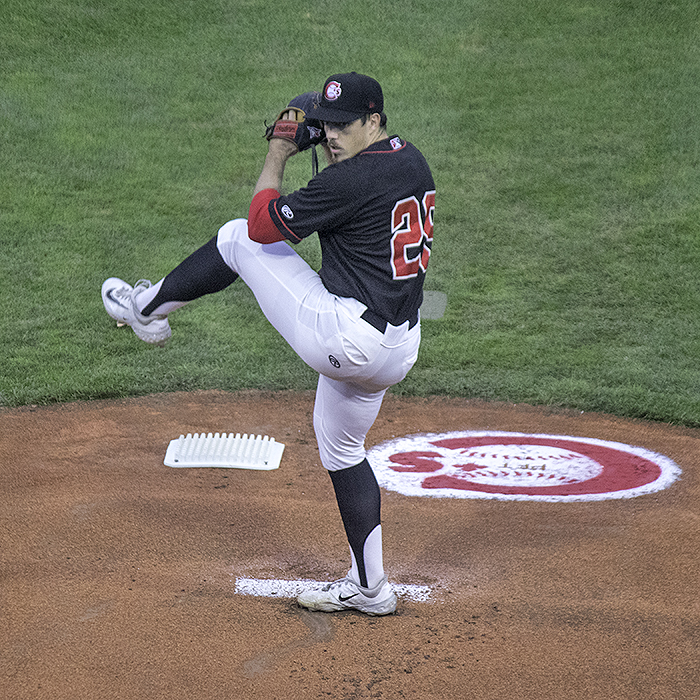
The latest C’s Chat is with 2023 Vancouver Canadians pitcher Ryan Jennings.

The San Antonio native played baseball and football at Smithson Valley High School in Spring Branch, Texas. Jennings had a couple of initial setbacks in the form of not making the junior varsity squad in his freshman and suffering a knee injury in football. However, he went on to make the varsity team and became an All-State pitcher and utility player in his senior season of 2017. Jennings also starred on the mound in the NBC (National Baseball Congress) World Series for the San Antonio Angels in 2018 and surrendered just one run in 12 innings, including a tournament-record performance at the time.
Wharton County Junior College allowed Jennings to continue playing baseball in the Lone Star State for the first two years of his post-secondary career. In 2018 and 2019, he was an All-Conference pitcher twice in the NJCAA Region XIV Athletic Conference. As a starter and reliever both season, Jennings won a combined 11 of 18 decisions with the Pioneers and posted a 3.99 earned run average and 147 strikeouts against 67 walks over 142 innings.
A transfer to Louisiana Tech was next for Jennings but an injury combined with the pandemic meant he would not pitch until the 2021 season. The redshirt junior became a full-time starter with the Bulldogs where he went 5-4 with a 4.48 ERA and a strikeout/walk total of 73-26. he tossed three complete games, including a nine-hitter two-hitter against Tulane on March 20.
Jennings’ 2022 season in Ruston saw him excel on the bump after an early bump on the road in which he was demoted to the bullpen. He found his way back to the starting rotation by striking out 14 batters over seven innings, allowing three runs to earn the win against Rice on April 9. Louisiana Tech would earn its first-ever Conference USA Tournament title by walking off UTSA (the University of Texas at San Antonio) 9-8 on May 28 with Jennings contributing a scoreless eighth inning for the ‘Diamond Dogs’. That gave Louisiana Tech an automatic bid and its second straight appearance in the NCAA Tournament. When it was all said and done, Jennings was named to the C-USA All-Tournament team after putting up a record of 5-1 with a 3.59 ERA over 90-1/3 innings. His peripherals stats checked in at 95 batters against 37 walks to give him a WHIP (walks and hits by innings pitched) ratio of 1.20.
The Toronto Blue Jays would choose Jennings with its fourth-round pick in the 2022 Major League Baseball draft on the advice of scout Chris Curtis. The 128th overall pick received a signing bonus of $70,000.
Jim Callis of MLB Pipeline had this to say about Jennings just after the righthander had been drafted.
““He’s a low-90s guy with good metrics on his pitches. He’s been up to 99 as a reliever. It’s a really funky arm action. Tough to pick up. A transfer from Wharton Junior College. He usually pitches more in that 92-94 range as a starter. The curveball can be a solid pitch.”
The Blue Jays decided to limit Jennings’ workload after he threw nearly 100 innings with Louisiana Tech by only giving him nine more—regular season and playoffs combined—in a late-season look with the Dunedin Blue Jays. He won his pro debut in Bradenton with two scoreless frames and two strikeouts on August 24 and had a 2.16 ERA to close out the regular season.
Jennings would be back in Dunedin for the start of the 2023 campaign and put together a pair of seven-strikeout efforts, giving up a combined two runs over seven innings against Tampa on April 14 and Bradenton on April 28.
After a 1.50 ERA over 12 April innings, Jennings had a tough go of it in May with one outing lasting just 1-1/3 innings. However, he bounced back with his longest outing as a pro by tossing a seven-inning complete game victory in which he gave up just one run and struck out six against Fort Myers on May 28. That was followed up with five shutout innings to get another win at Clearwater on June 4.
With a 44-14 K/BB total over 33 innings and a 4.36 ERA with the D-Jays, the Blue Jays brass decided to promote Jennings to Vancouver on June 6. His debut came on June 11 against Everett at Funko Field where he limited the AquaSox to one run over four innings—stranding a Harry Ford RBI triple—and striking out four in an eventual series-clinching win. His next outing was also on the road in Eugene where he struck out five over four frames but he gave up two runs to take the loss on June 21.
An elbow issue put Jennings on the injured list and he did not pitch again until the final week of the regular season when he tossed two shutout innings in Tri-City in the C’s final regular-season victory of 2023 on September 9. One week later, he would wind up pitching the final playoff game of the year against Everett, making his Nat Bailey Stadium debut in Game 4 of the Northwest League final. All the righthander did was strike out the side in his first inning on Canadian soil by fanning the top three prospects in the Seattle Mariner system Cole Young, Ford and Gabriel Gonzalez. That was part of three shutout stanzas of no-hit ball, working around a walk and a hit by pitch. The Vancouver offence took over from there and went on to win the Northwest League title three games to one with a convincing 10-2 victory on September 16.
C’s Plus Baseball was able to chat with the 24-year-old Jennings recently. The video of the chat is below along with a transcript that has been edited for clarity.
C’s Plus Baseball – You got a brief taste of pro ball with Dunedin in 2022 but you start back with the D-Jays in 2023. A good month in April. A few bumps in May, but you started to get things going again. (Your) last two (starts were) really good starts and you get the call up to Vancouver in June. Talk about first off, your second season in Dunedin and how you felt things went.
Ryan Jennings – Baseball is a up-and-down sport, so I started off really strong and maybe got a little comfortable there and had a couple of starts where things didn’t really go my way. But I mean, all credit to the staff and the guys around me for keeping me on track and not letting me get too far off with how things went. The organization’s been great—regardless of how you do, you’re doing good or doing bad —they try and keep you on a level playing field mentally throughout it all. They’ve really kind of had a lot of success with that lately so it’s been awesome so far.
CPB – I know your one start went 1-1/3 innings and it didn’t go great but then you had your longest start going seven innings, a complete game victory for yourself. Was there a mechanical adjustment you made, was it your mental approach or what happened?
RJ – No, it was just one of those games where it was a Sunday game and it was hot out there. I was exhausted, I probably didn’t get enough sleep or drink enough water. And by the second inning, I was starting to cramp. I felt like I had some pretty good stuff that day and I was just getting hit around and I think things kind of sped up. And that was kind of like the tipping point a little bit where it’s like, ‘Okay, let’s take a step back. Things aren’t going right.’ And that next week I said, ‘Alright, enough’s enough. We’re going to just throw strikes. We’re going to pitch just to what we have. We’re not going to try and do too much or try and overthrow things.’ Regardless of what happens, I’m just going to go out there and keep that level head. If they’re hitting me all over the park. So what? I know I have good stuff. Eventually it’ll come through. And luckily that next week it did come through.
CPB – As I mentioned, you started in Dunedin in 2022 after you were drafted and you had a full off-season to work with all the bells and whistles of the Player Development Complex. How did that help you going into 2023? Was there a specific way it helped you at all?
RJ – Yeah, I mean, having that facility is amazing. I mean, you show up after being at home for so long and you kind of forget how awesome it is down there. But I got to come in for a little bit of a strength camp and just having, like you said, all the bells and whistles, all the staff there. I mean, they feed you good. You got all the recovery motives you can possibly want. So it’s an awesome experience to have that just at your disposal pretty much any time. Especially with our pitching lab and the pitching coordinators that do a lot of work with that, being able to break down mechanics and have all that at your disposal. It’s awesome.
CPB – You got a few innings under your belt in 2022. What was that like when you first arrived in Dunedin? You had a pro camp to work with. You were joined by all the 2022 fellow draftees. What was that whole camp experience like for you in kind of getting used to what pro ball is going to be all about?
RJ – Yeah, the draft camp we had was actually really sweet. It was just kind of show up and get your work in. We had a little competitive day at the end of camp and it was I thought it was really awesome to kind of get there and get to know kind of my draft class really and get the feel for it. But then moving into the kind of the back half or back month of the season there, it was awesome. I mean, you just get back to baseball. It’s way different from school where in school you play three, four days a week with practice in between. In pro ball, it was definitely an adjustment where it’s a baseball, game day every day. So it was awesome. I loved it.
CPB – You get drafted in the fourth round in 2022. Did you have any idea it was going to be the Blue Jays who would take you?
RJ – I had no clue. I’d seen Chris Curtis a couple of times, my draft scout, but it really wasn’t kind of coming off that they were really hot on me. My agent, he made me up a spreadsheet with kind of like the teams (that were) hot and cold and when they would kind of show some interest and the Blue Jays really didn’t have a whole lot of interest, at least from his perspective, until the sixth, seventh round. And I actually got a call from my agent in the back half of the fourth round and he said, ‘Hey, the Rangers, the Texas Rangers are going to take you with their fifth-round pick.’ Moments later, he calls me like, ‘Hey, the Blue Jays are taking you right now’. They kind of snuck in there and surprised everyone, at least on my side. So yeah, it was a really cool experience. I mean, everyone says draft day is going to go by fast. It’s exciting, it’s nerve wracking and it was kind of like everything all at once too. So it was a cool experience.
CPB – Now you’re from Texas, were you a Rangers or Astros fan or who did you cheer for growing up?
RJ – I grew up a Rangers fan. I kind of got my first taste of being a Rangers fan in that 2010, 2011 time when they were going to the World Series. That kind of solidified my love for baseball. I was like, ‘This is awesome!’ So, yeah, growing up a Rangers fan. (As far as the) in-state rivalries, I’ve never had any trash talk or hate towards the Astros. I have a lot of friends that are Astros fans and it’s been cool to see kind of how they turned things around as well.
CPB – Did you go to a lot of Rangers games growing up?
RJ – Not really. We went to a few. My extended family is from Dallas. So when we go up there, it’s about a five-hour trip from us down here in San Antonio. But when we go up there, we kind of catch a game as we could. But I wish I could go to more games. I will say in Little League and everything, we had the San Antonio Missions, I think, the Double-A (affiliate) with the Padres. So we used to go to a lot of their games down here.
CPB – I guess you’ve been to the newer park that the Rangers have as compared to the Ballpark at Arlington, what it used to be known as for the longest time. Have you been to both parks at all?
RJ – Yeah, I grew up going to the old one. And man, we did it with four kids. We afforded the summertime day games so we kind of got the heat of it. But I made a game last summer before the draft to the new park and it’s beautiful.
CPB – I know you’re in the Blue Jays organization now but I’m sure it’s still got to be exciting for you these times with the World Series. The Rangers are that close now to winning their first ever World Series. But I guess a lot of excitement for you right now.
RJ – Yeah, it is. Everyone’s always saying, ‘Hey, you guys are doing so good.’ I’m like, ‘Hold on, let’s take a step back. I’m with the Blue Jays.’ I do like to root for the Rangers but if the Blue Jays were in it facing the Rangers…If it was in the ALCS, I’d be going Blue Jays all the way. As soon as that draft happened, I became the biggest Blue Jays fan.
CPB – Before you do arrive in the Blue Jays organization, you spent some time pitching with Louisiana Tech. Let’s take it back to where when you first began your baseball career. How did it all start for you? Take us through what led you on the path to eventually Wharton College and then Louisiana Tech.
RJ – My Dad (Kevin Jennings) was a high school baseball athlete, never made it college. But he was kind of my first coach from I don’t even know when. It was all so early when I started but just with T-Ball and all the way up, I was probably four or five years old. but we kind of grew up on a little bit of land out in the hill country. And he built us three mounds, two little league mounds and a full league mound. He kind of made it easy for me to love the game.
I played all the way through high school. I started in high school. I actually missed my freshman-year tryout. I didn’t make the team, that was JV (Junior Varsity) freshman. I didn’t make any of the teams. They put me on the practice squad. (They were) like, ‘Hey, like, when a job opens up, maybe we can get you in a game or something.’ So I was practicing but not playing. At the time, I was still playing football and in my sophomore year, I actually ended up breaking my leg in my last football game and I was always kind of around the baseball team.
And when I finally recovered, they’re like, ‘Yeah, we got a spot for you on the JV B-Team’, which is generally the freshman team. It was kind of a little bit of a slap in the face. I was like, ‘Man, I know I’m better than a lot of these guys.’ At the time, I was just, I don’t know, maybe 5(-foot-)5, 5-6 and maybe 120 pounds. I was a small kid at that point. But it was like, ‘I know fundamentally, I’m a lot better than a lot of these kids.’ And so it was a little frustrating but my close friends, especially my Dad and my family were like, ‘Hey, just, you know, keep working, it’s not about being the all-star all the time. I know things are tough but if you really want it, you just keep showing up and playing.’
And that next year, I committed it all to baseball where I was tired of football. I was like, ‘Baseball is more fun anyway, it’s kind of my sport, my speed.’ And so that following year, I actually ended up skipping our JV A-Team and making the varsity team. I was a relief pitcher and the starting shortstop halfway through the year so that was kind of like the biggest breakthrough.
My favourite story to tell is I went from not making even the JV-B freshman team to skipping it all and making the varsity team and (getting) a starting spot halfway through that following year. In high school, we played two games a week and you got two starters. I was one of the starters and the starting shortstop on the back end. So after that, I was actually about two or three weeks away from hanging up the cleats and just going to school and following my now-wife. So then my Dad was like, ‘Hey, let’s go try some junior college. Let’s go try a walk-on or tryouts.’
So he took me around for some tryouts. And luckily, Wharton County gave me a chance like, ‘We got some scholarship left. Like, there you go.’ I think in my tryout bullpen I was like top-end 88 or 89 (miles per hour). And I guess for a small junior college, that’s what they like. The guy that throws strikes and can kind of throw it a little bit. So my freshman year, I was one of the three starting pitchers and then kind of a backup shortstop. But after my freshman year, we cut that and went straight to pitching.
CPB – Who would you say has really helped you out developing as a pitcher? How did it all come about that you became a pitcher and eventually started working on your pitching style?
RJ – I have to credit it probably 90% to my Dad. I remember at one point, I think it was my sophomore year of high school, we were kind of doing some pitching stuff and a pitching coach comes over and was like, ‘Have you been doing pitching lessons?’ I was like, ‘No. it’s the same mechanics I’ve had my whole life.’ But it was all my Dad from that point. So he kind of created a very good mechanical base for me from that point on. And I’ve had a couple coaches here and there. In junior college, I had a good coach, wasn’t the best pitching, per se, coach but kind of a guy who pushed you and made you want to be good. And then I had a coach, Mike Silva, Louisiana Tech in my first year, that was by far one of my favourite coaches. Just another guy that told you how it was. I know if I had a tough bullpen. He was like, ‘Dude, you suck today. You would not start if you pitch like this, you would not start for us on a consistent basis.’ He’s just another guy that pushes you to want to be good, who you know you can be. So I credit a lot to those three.
CPB – I came across some video of you and you had a 14-strikeout performance, I think over seven innings against Rice but before that, you were knocked out of the rotation. You had a couple of bumps along the way but what helped you get back on the beam that season with Louisiana Tech?
RJ – Yeah, I kind of had a little bit of a rough start. And unfortunately, throughout my career, I’ve kind of been a slow starter but I kind of pick up speed as the season goes on. And there was a lot of pressure that year because we just went to a regional and were trying to fight back for it. Everyone kind of lost a lot of confidence in us because we lost a lot of our production. But I think the coaches were pressing a lot and I was pressing a lot. So kind of things broke through. And they were like, ‘Alright, take a reset. You’re going to the bullpen.’ And I kind of took that as ‘Alright, stop trying (so hard). I’m just going to go out there, once I cross those white lines, it’s just throw the ball, you’d put all the work in every other day.’
That’s kind of been a defining point in my career at this point because it helped me learn that I put in the work as much as I can. I feel like I’m a fairly hard worker and I do the right thing. So once I cross those white lines, I can trust that I’ve done what I can do. And then once I go into compete mode, it’s just whatever happens once the ball leaves my hand, it’s out of my control. So that’s the biggest thing there is that it taught me how to trust the work I’ve done. And from there you can kind of see how it unfolded is I went out there on the mound, it was just pitching and I left the overthinking off the field in the dugout and it was successful.
CPB – Your pitch mix right now, I’ve heard various things. I’ll leave it to you to explain what you do throw. I’ve heard fastball for curveball. I’ve heard four pitches. What is it that you are throwing right now? Or is there anything that you’re working on over the offseason?
RJ – Yeah, I throw a four-seam fastball, curveball, slider and a changeup. And a lot of the people say I throw a sinker or a cutter qnd unfortunately, I do but not intentionally. So that’s kind of one of the biggest things I’ve been working on this year is get a little more fastball consistency. Just get it when I throw in a four-seam, it’s a four-seam. And if I decide to throw a sinker, it’s a sinker. It’s not kind of the two mixing together. So yeah, it’s mainly those four pitches and maybe develop that fifth pitch because it’s kind of been a pretty good pitch whenever it’s, I guess, doing what it should do but not what I’m meaning for it to do. So it’s kind of a blessing, I guess, is I’m not meaning to make it nasty but it ends up being that way. So if I can learn to control it, it could be a weapon. But right now, that’s what I’m focusing on is trying to distinguish between the fastballs.
CPB – What would you say is your best off-speed pitch? Would you say it’s your curveball or would you say it’s your slider?
RJ – You could probably ask 10 or 15 different people and they probably give you each a different answer but it kind of varies on the day. The majority of the time, it seems to be the slider, especially the way the game tends to be leaning these days, the slider seems to be the better pitch of the two the majority of the days.
CPB – Now, of course, there are two variations of the slider, with the sweeper. I’ve seen you a pitch a little bit, but I’m not sure if a sweeper is the way you describe your slider.
RJ – No, mine’s more of a gyro. I guess you’d call it a gyro size, more of the conventional slider, where it’s kind of hard but a sharp drop at the end.
CPB – What is your pitching philosophy? How is it that you go and attack batters? It obviously depends on who’s batting and all that and looking at the scouting report but what is your battle plan when you’re facing batters?
RJ – It kind of changes, like you said, per hitter or per team but mostly I like to try to live up in the zone with the fastball. I have one metrically that plays in my favor where it’s got a lot more ride. And I think it that’s a lot of the reason the curveball is really successful is whenever I’m attacking the top of the zone with the fastball, the curveball lower in the zone is a lot better and plays up. So with those two pairing there and then the slider, everyone loves the pitch because it’s a lot harder than a normal slider for at least my fastball velocity. So those two pitches with the fastball and slider, they look very similar for a lot of the time it’s thrown. So, yeah, mostly it’s attack the top of the zone with the fastball. And then once you get ahead and hopefully stay ahead, it’s using those other two pitches to find ways to get guys out.
CPB – Let’s fast forward back to between Dunedin and Vancouver. You got the word you’re going to Vancouver. How did you find out about going to the Canadians?
RJ – I think I had a game in Clearwater where I had another pretty good outing. And I walked in, I was just finished, you know, doing the after-game duties. It was another Sunday and we were cleaning up the dugout. And the coach just pulled me in as I walk into the locker room. They kind of were like, ‘Hey, so do you want to go to Vancouver?’ I was like, I mean, ‘I’m not going to say no to that,’ you know? That’s exactly what every guy wants to hear. So it was awesome. The guys down there were close-knit and they’re all celebrating with you. It was bittersweet because I had a lot of friends on the team. It was like, ‘Man, I’m leaving all my good buddies down here.’ But I was like, ‘ I get to go up to Vancouver and get a promotion and meet a whole bunch of my buddies up there too so it was a really cool experience.’ Hopefully, I have two more of (those promotions) and get to stay in the big leagues at some point.
CPB – So you arrive, I guess it was in Everett. That’s where I first saw you. I was actually down for that weekend in Everett. Unfortunately, I didn’t get to see you pitch live as I had to leave the next day but I was there for that double header. (When you first joined the team, did you fly in to Seattle?)
RJ – Actually, I landed in Vancouver on our off day on Monday. And then I think we left for (Everett) on Tuesday. So I kind of got about, I don’t know, 12 to 24 hours in Vancouver to kind of set my suitcase down and sleep. But yeah, I hopped on the bus with the team on Monday to head to Everett.
CPB – And the way the rotation worked out, we did not get to see you pitch in Vancouver, at least not yet. We will get to that when you finally do get to pitch in Vancouver. But yeah, you arrived basically in the heat of a big divisional race. The team was trying to hold off Spokane for first place in the first half of the season. What was your sense of what was going on with the team when you arrived getting ready for that big series in Everett?
RJ – Yeah, the guys up there were awesome. The coaches, all the staff was awesome. It was just kind of a mentality where you just show up and play. The guys were very relaxed, where you can be on some teams where it’s a lot of pressing, especially when things kind of come down like you said to that race where I think it was within just a couple games and things can go south real quick. But everyone up there just knew what we were capable of so it made it easy to show up. The guys just did what they do, you know? It wasn’t like we have to do more, they’re on our tails. It was just go out there and play baseball. So it was a really cool environment to be coming into at least seeing how the pressure was building. But the pressing, I guess you could say by the players, wasn’t.
CPB – Well, you were there for two really big moments. The Garrett Spain game with the Grand Slam, that comeback victory, Lyle Lin keeping the rally alive with a bloop single. Next thing you know, a huge come-from-behind victory in the ninth. You were there for the doubleheader sweep, (that included) a no-hitter. Did you get the sense that something special is really going on this team, that this could be a team of destiny?
RJ – Yeah, it was a great week to be a part of it. And unfortunately, after Devereaux (Devereaux Harrison), we finished that no-hitter, I was like, ‘Okay, I got to follow this up tomorrow.’ So I tried not to put too much pressure on myself. I’m just going to go out there and do what I do. So it was an awesome week to be a part of (the team). Because I mean, like I said, they just show up and play. It wasn’t (about) trying to do too much. I mean, all those guys are awesome. It was just baseball kind of in its purest form.
CPB – With your Northwest League debut coming in Everett. What was that like pitching that park? I’ve said it many a time. I think it’s the Fenway Park of the Northwest League. So many funky dimensions and a very small ballpark. But how did you approach making that start in Everett that day?
RJ – Yeah, that was definitely kind of an eye-opening experience going from the Florida League down there where you’re playing at all the spring training sites. And then you go up there and you get a whole bunch of different stadiums. And I thought it was really cool and unique. It’s a unique stadium. I mean, you walk up, you’re like, you would not expect technically big league guys to be playing on this field. But it was actually really fun to be a part of it and kind of see the different dimensions. I just tried to approach it like every other day where it’s you go out there and they preach ‘throw strikes.’ And that’s just what I wanted to do.
I know I had a shorter leash that day having the travelling and getting used to the weather and all the different changes. So I had a little shorter leash. And I was like, ‘Man, I’m just gonna go out there and throw the ball over the plate and see what I’m going up against here.’ Because you’re going to a level up so you never really know how big of a step or how small of a step it is. So it’s just ‘Let’s throw the stuff in the zone, see how it plays and see what happens.’
CPB – Well, you return to Vancouver. We didn’t get to see you pitch on the homestand. That’s the way the rotation schedule worked out. But you did pitch in Eugene. What was that like for you pitching at PK Park, the home of the two-time champion Eugene Emeralds at the time?
RJ – Actually, that week before I ended up getting sick, that’s probably the reason I missed you all (in Vancouver). I kind of credit it to going from Florida to 55 (degrees) and rainy in Everett. It just kind of poured me down. Unfortunately, I was sick for three or four days of that series. I got to travel again on the road to Eugene. That was another really cool experience. I mean, I grew up watching college sports at Oregon’s baseball field. And I mean, that was kind of a cool, cool thing to be a part of. As a kid, you idolize these big old stadiums like that. And I got to play at LSU once or twice. So being at another stadium where it’s like these big Division I players play, which now it’s kind of in the past, but it was kind of cool to see a different perspective of that. And yeah, that’s what I heard all the stories, the guys that were there the year before, like Eugene was kind of the team to beat in the league a lot of the time. So it was cool to kind of get there and compete against those guys.
CPB – You mentioned LSU, I guess you probably faced (Vancouver Canadians teammate) Cade Doughty at some point then.
RJ – Oh yeah, we go back and forth a little bit. I guess in my senior year, I faced him at The Box (Alex Box Stadium) at LSU. And he flew out to deep left-center field at the wall. He’s like, ‘Man, I almost hit a home run off you.’ I was like, ‘Yeah, but you didn’t. It was an out.’ We kind of go back and forth a little bit.
CPB – Yeah, the one thing I do know about Cade is he doesn’t mind giving it back to people. I know he and Josh Kasevich have their conversations when they faced each other during the regionals (LSU and Oregon) and all that. You’re pitching in Eugene and after that, we did not hear from you until September. I had heard (it was due to) injury, what happened?
RJ – What I really think happened was I had three days off of being sick the week before Eugene, and I kinda had four days to ramp up to throw in a game. And I think my body just kind of reacted in a bad way to it. It wasn’t anything serious. I think I had some compression on my nerves. I was causing some tightness. It went away in four or five days, which it typically does. I throw a day after it’s tight and then I’m ready to go by the weekend. But they wanted to be cautious with it just in case it was getting down to the end of the season. So I went back after the All-Star break. I had about two weeks off of resting and felt healthy at that point but they wanted to be cautious with it. So I went down to Florida for a little rehab and spent I think about eight weeks there. But I mean, like you said earlier, you get to utilize everything there (at the Player Development Complex). I had three or four PTs (Physical Therapists) always working on me. The weight room staff was awesome. I mean, food every day, breakfast, lunch and dinner pretty much so I couldn’t complain too much of the fact I wasn’t with the guys up in Vancouver. But I kept up with them the whole way. They had a couple of rough stints there. I think guys were getting injured and sick. They’re moving guys up and down so it’s kind of a weird dynamic there but once I got back up there, it was kind of just like we picked up where we left off.
CPB – It was a shoulder issue then or a nerve issue that was the problem?
RJ – It was the right elbow.
CPB – You must (have been) relieved that at least you didn’t need like Tommy John surgery or something like that because that’s a pitcher’s worst nightmare obviously.
RJ – Yeah, I kind of was dealing with it for the past few years, it just kind of comes and goes. It’s just kind of something I add to my prep work because I got to be wary of it. It’s nothing too serious. It was just kind of a little setback but everything was alright.
CPB – So the next time we see a pitch is in Tri-City. And basically, you’re more or less coming in cold. I know you’re down in Dunedin trying to rehab and get ready. Maybe you had simulated games or anything like that? How did you prepare to get ready for that final start in Tri-City during the regular season?
RJ – Yeah, they did a really good job out of rehab in kind of building you up and taking the time to make sure you’re healthy and good to go. So I had a handful of bullpens, probably five or six bullpens at that point. I’d had, I think, two live outings where it was just kind of a hitter and catcher/pitcher and then one where it was kind of a sim game a little bit where we did have a couple of coaches playing positions but kind of mimic it as much as possible. But yeah, going out into that game, I definitely had the heart racing a little bit. My first batter, I think I went 3-0 (in the count). I was like, ‘Okay, let me step back. Let me take a breath.’ I know I’m in a game but it was just exciting to be back out there. I kind of been itching to get back out there for pretty much eight weeks once I went to rehab.
CPB – So you got in two innings (against) Tri City. The playoffs began and you’re getting ready for the Everett Sox. The guys managed to gain a split. Game 3, a real nail biter, probably the most nerve-wracking game I think I’ve ever witnessed live but a game that the Canadians pulled out 1-0. When did you learn you were going to get the start for Game 4?
RJ – I think I threw on a Saturday so that was kind of my schedule is every Saturday. And I know if we were making the playoffs, which we knew at that point we were doing, I was gonna pitch on Saturday. So I kind of knew going into it, I’d most likely pitch that that week. And then once the regular season ended, they kind of let us know how it’s gonna play out. And it was awesome.
RJ – The first inning. Wow, what a way to start. You finally get to pitch at Nat Bailey Stadium. You strike out the side and not just any three batters, only the Mariners top three prospects. I know you probably would have faced Harry Ford, but you faced Gabriel Gonzalez, you faced Cole Young. What a way to start that first inning. What do you remember about it, striking out the side?
RJ – Man, I mean, that stadium is…I got the experience from the bullpen a little bit sitting out there with the guys and seeing them go out and play while I was resting from the injury. But getting on the mound while there were 6,500 people there rooting you on. That probably helped me the most. It’s one thing to pitch in an environment where people show up and are rooting against you. It’s another thing to have the whole city really behind you and facing those three hitters. No offense to any of those guys (from Everett). I like to try and go out there and not think about who I’m facing because as soon as I say ‘The number one prospect is in the box, I start pressing a little bit. I try to keep that out of my mind as much as possible. So that was probably the first time I heard that they were the top three prospects, which kind of makes me feel pretty good about myself now, but I mean, all credit to those guys because I mean, they’re at the same level we are and they’ve gotten the recognition they deserve. I mean, it’s awesome to hear that’s how it turned out for me because I didn’t know that until you said that so that’s pretty cool.
CPB – You threw 51 pitches. Did you know coming in, you were on a pitch count. Was 50 the magic number or just try and get as many outs as you can. What was the game plan?
RJ – During rehab, my max was two innings, you get two innings. That was the plan was to go to two innings for my last two starts. After my first outing in Tri-City, I was like ‘Come on. Let’s see what we can do and give me a third inning.’ I borderline begged (manager Brent Lavallee) to let me have a third inning (in Game 4). I told him, ‘I feel good. I feel healthy. As long as I keep the pitch count reasonable, let me go three.’ They nodded their heads and said ‘Three innings.’ I think it was a 60- or 65-pitch limit but I snuck underneath that. I was really happy that they let me do that.
CPB – Eventually the team really pours it on. Anders Tolhurst, Eric Pardinho and Justin Kelly finish it off. What was it like when Justin Kelly finally threw that final pitch, getting Blake Rambusch lining out to Josh Kasevich. Take us through where you were running from the field. Take us through what that experience was like in getting to join the dogpile.
RJ – I was actually sitting there talking to Anders. Once we got two outs, we were kind of all along the edge of our seats there and leaning over the netting. I was getting chills thinking about it. Regardless of what level you’re at, winning a championship, you can’t put it into words. Once it happened, we actually were all debating, ‘Are we going to jump over this fence or are we going out the edges?’ As soon as it happened, we were like, ‘Screw it, we’re going over. We’re not wasting any time getting out there to celebrate.’ It was awesome. I couldn’t wish (the championship) for a better group of guys, especially the guys who were there all year grinding it out. I kinda felt like I cheated the system a little bit. I skipped almost half the season and snuck in for a championship. It was awesome to get to be a part of it.
CPB – Would you say that was your best baseball moment ever? Can anything top that other than eventually getting to the big leagues? For you, is that the pinnacle right now?
RJ – It is pretty darn close. My senior year we won our Conference Championship Tournament on a walk-off. That one may rival it a little bit just considering it was a walk-off and it was in the senior season to send us to the regional. They’re close. Championships are championships. You could probably ask most big leaguers or athletes, it’s like no championship really beats another (championship) other than the fact that maybe the team you were on or the situation that caused it but championships are kinda the peak of where you want to be at.
CPB – Final question I want to ask. Did you have a favourite major leaguer growing up, pitcher or player?
RJ – Growing up, my Dad was old-fashioned. I always loved Nolan Ryan. I always had a picture of Nolan Ryan in my bedroom. Growing up a Rangers fan, I kinda idolized the guys that were on the 2010, ’11 (teams) because those were the guys I grew up around. As I kinda grew up a little bit, I kinda realized I gotta find someone who is like me that I can kind of manipulate my game, my mechanics to kind of do that. I really got into Trevor Bauer there for a while. He was really good about kind of promoting the game and growing the game on his YouTube channel and stuff like that. I kind of learned a lot of mechanical information through him and kind of watching him compete and everything especially a Cy Young Award winner. Why would you not watch a guy like that?
Now I kind of transitioned into watching Spencer Strider, a guy that’s a similar height and build who has a lot of success at the big league level. Obviously, there’s things he does a lot better than I do. If we stood next to each other, he’s probably got bigger legs than me but we’re very similar in the way we are built and really, I think the way we pitch mechanically. I try to use him as much as possible to kind of guide (me) where I want to go because a guy that’s at 96 to 100 (miles per hour) and striking out the house every time he goes out and faces the best players in the world is not too bad of a guy to use as a guide.
Ryan Jennings File
- Born – June 23, 1999 in San Antonio, Texas
- Height/Weight – 6-foot-0, 190 pounds
- Bats/Throws – Right/Right
- Uniform Numbers – Wore number 9 with Wharton College in 2018 and 2019 and number, wore number 16 in 2021 and number 3 with Louisiana Tech in 2022. Wore number 48 in 2022 and number 8 with the Dunedin Blue Jays in 2023. Wore number 32 and 41 with the Vancouver Canadians in 2023 before wearing number 29.
- Instagram – @ryan3jennings
- Academic Achiever – Made the Conference-USA Commissioner’s Honour Roll in 2020, 2021 and 2022 and was a two-time Academic All-District selection at Smithson Valley High School.
- The More You Know – Jennings is the second pitcher drafted by the Toronto Blue Jays from Louisiana Tech. The first was fellow righthander Rusty Ringmire who was taken in the 24th round of the 1982 MLB Draft and spent his lone season in pro ball with the Medicine Hat Blue Jays of the Pioneer League.
Thanks a million again to Ryan Jennings for taking part in the latest episode of C’s Chat.
Discover more from C's Plus Baseball | A Vancouver Canadians Blog
Subscribe to get the latest posts sent to your email.


 C's Plus Baseball | A Vancouver Canadians Blog