

The latest C’s Chat is with 2024 Vancouver Canadians catcher Robert Brooks.

The Marietta, Georgia native is looking to make good on his first extended opportunity in professional baseball. He was with the Tampa Bay Rays organization in 2023 and played nine games at the Florida Complex League and collected his first two hits against the FCL Red Sox on June 29. Brooks was let go by the Rays at the end of 2024 Spring Training but was able to catch on with the Staten Island FerryHawks of the independent Atlantic League, the same team 2023-2024 C’s infielder Jeff Wehler played for last season. Brooks’ stay in New York State lasted just 27 games as he put up a batting line of .354/.514/.646. That included five doubles, six home runs and 20 runs batted in and a perfect 3-for-3 in the stolen base department. After winning back-to-back Atlantic League Player of the Week honours, Brooks was signed as a free agent by the Toronto Blue Jays on June 8.
The video game numbers posted by Brooks with Staten Island was not the first time he reached that level of performance. The four-time letterman at Wheeler High School in Marietta enjoyed a standout five-year career with Division II Columbus State where he compiled a slash line of .353/.481/.652 from 2018-2022. When he was done with the Cougars, he set the Peach Belt Conference career mark for home runs with 66. He had 301 total hits, 118 of them for extra bases. Brooks was also efficient in his stolen base attempts by going 9-for-11.
A four-time PBC Player of the Week winner in his collegiate career, Brooks helped the Cougars win the NCAA Southeast Regional title in 2018 to earn a trip to the Division II National Championships to go along with the 2021 PBC Tournament title and 2022 PBC regular-season championship. In 2022, Brooks led the Peach Belt Conference in batting average, on-base percentage, OPS, runs scored, hits and RBI and was second in slugging percentage and home runs.
Brooks was also busy on the summer college ball circuit. He was with the Macon Bacon of the Coastal Plain League in 2020 and batted .400/.552/.780 with four doubles, five homers and 18 RBI in 18 games. He was also a hit with his teammates off the field.
In 2022, Brooks spent time with the Holly Springs Salamanders and had a .981 on-base-plus-slugging percentage with three homers and 10 RBI, earning him a Coastal Plain League All-Star selection.
Salamanders head coach Brian Rountree had lots of good things to say about Brooks.
“Brooks is a good leader. He not only leads when he’s on the field, but when he’s not playing, he leads in the dugout. Brooks is even-keeled and everything is positive and optimistic.”
From there, Brooks joined the Frederick Keys of the MLB Draft League and continued to post outstanding numbers with a .997 OPS, eight extra-base hits and 15 RBI in 26 contests.
The next team Brooks was going to join was the Missoula PaddleHeads of the Pioneer League for the 2023 campaign but that was when the Tampa Bay Rays came calling. Though Brooks was not coming to Montana, PaddleHeads manager Michael Schlact was pleased to see Brooks getting the opportunity to play pro ball.
“Robert is a very talented baseball player and a cerebral catcher. It’s no wonder he attracted the attention of many MLB teams. We are excited to watch Robert as he progresses through the ranks and wish him the very best in his journey to the show.”
Now Brooks is north of the border with the Vancouver Canadians and he has made an early impact with the club. He threw out two baserunners and scored a run in his Northwest League debut in Everett when the C’s rallied from a 7-0 deficit to beat the AquaSox on June 8. In his first game at Nat Bailey Stadium, he had a hit and a walk against Spokane on June 12. His first multi-hit effort came in a victory over Spokane on June 15 and he reached base four times in Tri-City with three hits and a walk on June 20.
It was on July 2 when Brooks hit his first professional home run and it was not a cheapie as he cleared the center field wall of Nat Bailey Stadium in a win over Everett. He went yard twice in Eugene as his home run on July 10 sparked a six-run second inning in a win over the Emeralds. His second blast with a three-run shot to give the C’s a come from behind victory over the Em’s on July 14.
C’s Plus Baseball had a chance to talk to the 25-year-old Brooks during the team’s homestand against Hillsboro in late June. This interview has been edited for clarity.
C’s Plus Baseball – Let’s first start off how you arrived here in the Blue Jays organization. How did that all come about?
Robert Brooks – I was with Staten Island in the Atlantic League. I felt like I was doing pretty well. The ownership over there had some phone calls with some people that they knew with the Blue Jays and next thing I knew, I was on a plane on the way to Seattle to meet up with the team in Everett.
CPB – Who got a hold of you from the Blue Jays?
RB – Charlie (Director of Minor League Operations Charlie Wilson) was the first one to reach out to me. I had some good phone calls and conversations there, kind of just working out some logistics of how to get me from where I was. I was actually on the road. We were on the road in North Carolina so I had to fly from North Carolina back to New York, drive from New York to Maryland to meet up at my fiance’s house, drop all my stuff there and get on a plane from Baltimore to Seattle.
CPB – And you arrived during the Everett series?
RB – Yeah, I met up with the team in Everett. That was my first series there. Got acclimated a little bit in game one, got in there for game two. I faced a guy that I just found out today was going to Double-A. He was pretty good. So that was a fun welcome to High-A.
CPB – That was Brandyn Garcia?
RB – Yeah, Brandyn Garcia. He got called up today or yesterday so yeah, that was a fun. He punched my ticket a couple of times. He was a really solid arm so seeing him go to Double-A makes a lot of sense but that was a good welcome to High-A. I got back on the bus and came back got to experience what it’s like in Vancouver with all these fantastic fans and how good this team is.
CPB – You were with the Tampa Bay Rays but how did you wind up with Staten Island?
RB – My agent definitely helped me out. I had a couple of people that were hoping I would go some place. I had an opportunity to go to the Atlantic League. I understood that that was one of the better leagues for independent ball. Got some connections over in Staten Island and I just got to go over there and I’m so glad I did. The coaching staff over there, the players, just getting to play with some all-time greats like Pablo Sandoval. Got to meet Drew Maggi a little bit while he was there. And just some of the guys just getting to share different experiences, different talents. Everyone brings something different to the table and that’s what makes it a great team over there. And I can’t speak enough about the management, about the ownership, about the coaching staff. And I do miss them a lot. They were a good group of guys and I can’t thank them enough for helping me get here.
CPB – You put up really good stats with Columbus State and very similar stats with Staten Island, what was working for you there?
RB – Just trusting myself and knowing that I can compete at any level. I have yet to get to a level where I can’t (compete) and I’d like to take that mentality with me and make it to the big leagues one day. Just know that at every level I can compete and know that there isn’t really anything that I can’t handle and just kind of go out there and trust myself, know that swing changes are going to come, defensive changes are going to come. But as long as I continue to trust myself and go out there and compete, I know I can handle anything that’s put in front of me.
CPB – Jeff Wehler was with Staten Island last year. Did you to get a chance to compare notes with him?
RB – We did have some similarities and knew a couple of same people with the owner. The management changed and the coaching staff changed since we were there so we didn’t get to talk about different things or the same similarities in coaching. Just being able to talk about the field and the area and being able to hop on the ferry and be in Manhattan was really, really cool. Seeing how Jeff has embodied what it’s like to be a (Vancouver) Canadian here and just see how he treats you and how hard he plays. I’ve only gotten to see him play a couple times now coming back from the injured list but watching the way that he takes over the clubhouse and how he really is the captain. That’s really fun to see a guy that came from similar shoes to mine and that you can become somebody like Jeff Wehler.
CPB – How did you get started in baseball? Take us through the timeline that set you get to Columbus State. Were you always a catcher?
RB – I started playing baseball when I was seven. I wanted to play when I was five. My Dad wouldn’t let me yet. He wanted to make sure that I could protect myself and I’m thankful for that. I started watching baseball games with him when I was young and just fell in love with it. I was playing a couple of different sports when I was younger but I really bought into baseball, around 10 (years old), right around middle school but I was playing since I was seven. I started catching when I was nine. Mike Piazza was my guy. I loved watching Mike Piazza and I was like, ‘I want to be like him.’ I went to Wheeler High School in Marietta, Georgia and made varsity as a freshman and was able to kind of learn from some of the older guys there and understand you know how to carry yourself around people that are, quote-unquote, better than you, and just older than yo. Just being able to compete as an underdog, I guess you could say. I really attest a lot of my time to the coach that’s still there, Mark Collins. He really helped me out a lot. I loved learning from him. I really grew into myself at Nelson Baseball school, shout-out to Coach Nelson, he was awesome. I found my way into Columbus State and the same mentality goes there. I know that I can compete at any level and just go out there and do my thing and the rest takes care of itself.
CPB – How did you wind up at Columbus State. Were there there any other schools you were considering?
RB – Yeah, I had about three offers coming out of high school. Two D2s and one junior college. I had interest from a smaller Division I but it was kind of after I already committed. I was just a little bit of an undersized guy coming out of high school. I went to Columbus State and just found my way and had a lot of really great teammates that took me under their wing and showed me what it’s like and how to work and put on a lot of muscle. I became the hitter I am today because of those teammates I had.
CPB – You find your way to Tampa Bay. I don’t know if you want to comment on your brief experience there, but what was that like being with Tampa?
RB – I was a free agent and signed about a week before camp in ’23. I wasn’t really prepared for it. I was more preparing for a couple months down the road in independent ball. I was already signed to go play in Missoula, Montana but I never actually got there. I got to spring training, got to learn what it was like and live out the dream of being a professional baseball player. That’s the first step and I got to learn a lot. That was my biggest takeaway from Tampa. I had a lot of really great coaches that helped me out a lot over there. I can’t speak highly enough about the way that they were intentional with their time and it didn’t really matter if you were a top prospect or a no-name free agent sign. They made sure that they took intentional time to make sure that you learned and you understood how to go about your business the right way and how they wanted you to do it. I can’t speak highly enough about some of the coaches over there and just the coaching staff and the front office people who treated me very, very well. Even when it was time for me to leave, they handled it with a lot of respect and I can never speak highly more highly enough about the people over there.
CPB – I came across a press release from Missoula that wished you the best (with Tampa). I thought that said a lot about you and about Missoula that you know they were pretty classy and they were happy to see you go on to the next level.
RB – Yeah, I think that’s kind of the goal of most independent leagues and most independent teams. I would like to think it’s to make sure that you get guys going out and have a good turnaround of guys. Michael Schlact, the manager over there, he and I have a relationship for when he coached me in high school. He was somebody that I wanted to play for a while again. Their goal is to get you out (to affiliated baseball) and the fact that I didn’t even have to go there, I would like to think speaks for my talent level. I wish I would have gotten to go out there and experience what life is like in Montana and just understand how beautiful that area and how good the team is and how good the culture is over there. I’ve heard nothing but great things over there and I’m glad to see that they’re doing well.
RB – As far as catching goes, what’s your favorite aspect of it?
RB – I just like being the field general, the field leader, you know? I’m the only one that can see everything and being able to know that even if I don’t know these guys that well, I’ve been here, this is going on my third full week, being able to manage a team and knowing that they trust me, that’s a really huge thing. I think this team’s done a fantastic job of bringing me in and understanding I’m new but I’m a Canadian, just like they are. That makes me really, really happy to know that it doesn’t really matter if you’ve been here all year or two years. Everyone’s the same, everyone works the same and everyone wins the same. Being a catcher on this team and knowing that our pitching staff is as great as it is knowing that they trust me in my pitch calling and learning how they pitch. I’d like to say that my favourite aspect is that field generalship of being able to help the team win however I can do it.
CPB – How do you go about breaking the ice wiht your pitchers? I know the coaches help you out with that but eventually you have to be one-on-one with these pitchers. How do you go about breaking the ice?
RB – I feel like I’ve always been a pretty outgoing person. My fiance’s Mom likes to say that I know no strangers so being able to go up and talk to anybody and be able to kind of have that relationship with anybody like I’ve known them my whole life. I think one thing that really helped me from my situation with the Rays was I was surrounded by a lot of Latin American teammates. So I learned and I picked up on Spanish pretty well. I wouldn’t say I’m fluent by any means, but I know enough to get by and understand that I can communicate with pitchers who don’t speak English. So being able to be that guy that is able to communicate with both English and Latin American pitchers definitely really helps me be more versatile to help with that. So being able to break the ice that way and understand what they want, what pitches they have, what signs they want, all of those things. For them to be able to trust me, that helps me out a lot too.
CPB – When you’re behind the plate, there’s so many facets to the job such as calling your own games and setting up behind the plate. What is your process when you get behind the plate?
RB – I think the most important thing is building a relationship with the umpires as much as you can because as much as you see them on the other side, they’re people too, they’re your friends too. They can help you out along the way, especially if you think they miss a call. As long as you’re nice about it, you can kind of let them know and they’ll work with you a lot better. But I think it’s just important to kind of understand we have a lot of meetings before the week starts, before games start about lineups and how to pitch certain guys certain ways. But I think it’s really important that we understand we pitch to our pitcher’s strengths rather than a hitter’s weakness because that just instills confidence in our pitching staff and in our pitchers to throw their best pitches. Just understanding the other team a little bit too helps with me managing the running game and helps our pitchers understand and manage the running game too. You have certain teams that run a lot more than others and just understanding that kind of game plan.
RB – Speaking of umpires, you were shown on the @VanCanadians social media channel shaking hands with umpire Isabella Robb. Is that something you’ve always done?
RB – Yeah. At the end of the day it’s a respect thing. I think it’s something that’s really important, that you build relationships with these umpires. It’s one of those things that before the game, you introduce yourself. Even if I’ve seen Isabella three times now or Nate (Nathan Hall), who will be behind the plate tonight. I’ve caught for Nate. I think this will be my fourth or fifth time. I’m going to go out there. I’m going to shake his hand. He is someone to be respected out here and he is somebody to be understood. And at the end of the game, when you work with somebody, at the end of a business deal, you stand up and you shake hands. And this is it for us. This is our work day. At the end of our work day, I’ll stand up and I’ll shake his hand.
CPB – When did you start doing that?
RB – As soon as I started catching. I had a really good catching coach when I was younger and just kind of understand that these are relationships you build and these are relationships that are understood that you need to make sure you have, regardless of who they are, how much they’ve called against you, how much they may have not helped you throughout the game. It’s a business deal, and this is your business. This is your job, and it’s a respect thing for me. Dennis Jordan was one of the catching coaches I kind of had a lot of my initial teachings with and it kind of started there. And since then, it’s just been something that I teach. When I’m giving lessons in the offseason or anything like that. I say, ‘Hey, the number one important relationship is that umpire. You go out there, you shake his or her hand, and you learn their name.’ You go out there, you can talk to them throughout the game. They’re people too. Go out there and have a good relationship with them. You never know when it could help you.
CPB – As far as setting up behind the plate, I notice sometimes you stretch the leg out. When did you kind of adopt that style of catching?
RB – I was going one knee down. That was how we were taught with the Rays, that we were exclusively one knee down. Left or right knee doesn’t really matter with nobody on base, but once there’s a runner on base, it’ll be right knee down. You’ll notice I’ll always be right knee down with a runner on base, and very rarely am I going to kick out with a runner on base. I put myself in a good position to throw, block, and receive from that right knee down stance. When I kick out, it’s usually to give myself a better target for the pitcher and give myself a better chance to receive the ball properly. But that’ll really only be with nobody on because I am in a less athletic position there that I’m kind of selling out to receive the ball well.
CPB – I also wanted to ask as well about the hockey goalie style of mask. When did you start wearing that?
RB – I never wore a two-piece. Never been a fan of them. I just don’t feel protected with them. And I wear glasses while I play too so that kind of becomes factor. If the two-piece is going to be sliding around a little bit, that’ll mess up the glasses. So I just always rocked with the hockey-style mask. I fell in love with it and figured out how to use it. Pop-ups, I don’t really take it off. I just learn how to see through it, and yeah, just have to make some modifications to it sometimes with my glasses, but I’ll never stray away from it.
CPB – Let’s go to the hitting aspect of things. How have you found it hitting here at Nat Bailey Stadium? I guess you could say it’s a fairly neutral park, maybe shading more towards a pitcher’s park.
RB – I think you’d be right saying it’s shading more towards a pitcher’s park with the high walls and winds not always blowing out. You have a short porch to left but I think people very rarely pull the ball down the line as often as they stay to the middle of the field. So, yeah, definitely, in my opinion, it’s a pitcher’s park until I hit a home run. Then it’ll be a hitter’s park. But yeah, this place is absolutely beautiful. You can’t say enough about how well the grounds crew takes care of it. The grass is green every day. The dirt’s always nice. It’s perfectly watered. Home plate’s beautiful. It’s just a really, really cool area. Sometimes it feels like we have 8,000 people here. It’s an amazing crowd, an amazing turnout. People that love seeing the Canadians win and i’m happy to say that we’ve been doing that a lot. It feels good to give the crowd what they want.
CPB – So far, you’ve been able to succeed with runners in scoring position. What is your approach when you come up to the plate?
RB – One line drive. Just try and hit one-line drive. Go 1-for-1. That’s what I have found helps my team the best. There will be times I take more selfish swings, no doubt, trying to see how far I can hit one. But I think there’s a time and place for that. Like, for example, I think with two strikes and runners on less than two outs, the worst thing you can do there is strike out. The best thing you can do there is either move a runner or get them in. Even if it’s a sac fly or a groundout up the middle, having that approach really, really helps to kind of mitigate the strike out, which is what I try and not do with two strikes. With nobody on, I’m more okay with striking out because I’d like to drive the ball in the gap beyond second so that my teammates can drive me in. But until then, it’s about doing a job and helping the team.
CPB – I know you said Mike Piazza was someone you looked up to but was it the Braves that you cheered for as a kid?
RB – I was a born and raised a Mets fan but once you kind of step into professional baseball, you’re a fan of professional baseball. And I do enjoy just watching it. I’ve been enjoying watching the Blue Jays recently and seeing how they’ve been doing. I’ve been a fan of my friends that have made it with the Rays and watching a lot more minor league baseball now and just becoming a fan of players has been really, really important to me. And rooting for guys that are above you, with you, below you, rooting for everybody’s success.
CPB – Final question. The Canadians have five different uniforms—red, black, white, gray and blue. Do you have a favourite?
RB – I do. The blue Canadians one with the Canadians hat is definitely my favorite to look at. I think it’s really cool. I’d have to say the blue, I think we’re in red today but O’Halloran (Connor O’Halloran) is kind of exclusively the blue guy. But yeah, it was really cool to wear those the other day. I got a win in them and I kind of want to keep going with the good win streak.
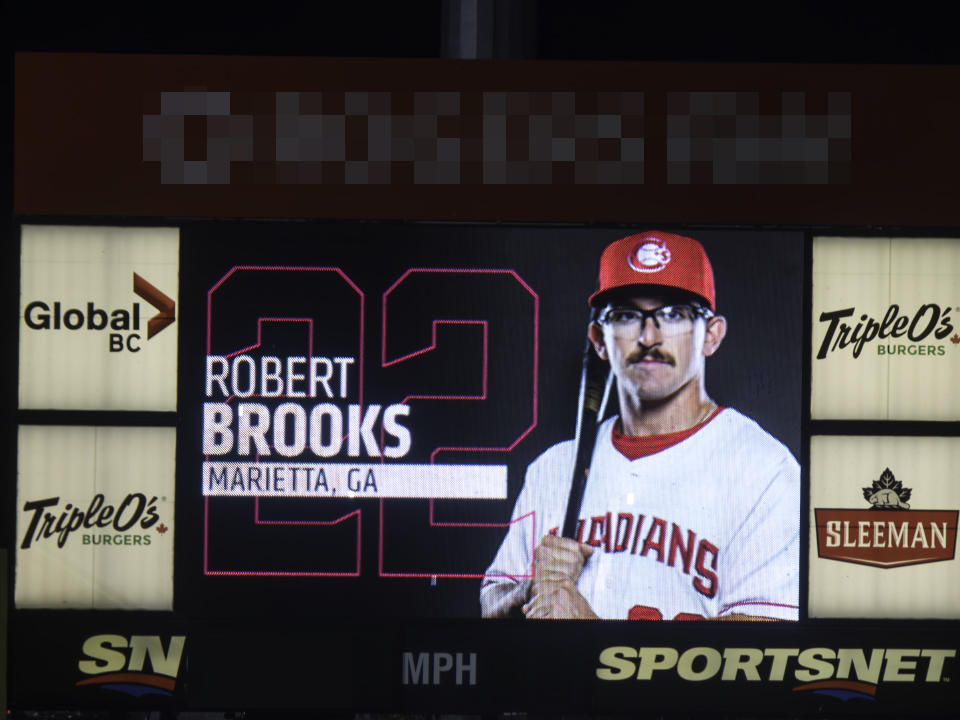
Robert Brooks File
- Born – November 21, 1998 in Marietta, Georgia
- Height/Weight – 5-foot-8, 215 pounds
- Bats/Throws – Right/Right
- Uniform Numbers – Wore number 19 with Columbus State in from 2018-2022. Wore number 37 with the Macon Bacon of the Coastal Plain League. Wore number 22 with the Holly Springs Salamanders of the Coastal Plain League and number 50 with the Frederick Keys of the MLB Draft League in 2022. Wore number 50 with the Florida Complex League Rays in 2023. Wore number 19 with the Staten Island FerryHawks in 2024.
- Twitter – @bashbrooks2
- Instagram – @robertbrooks2
- Fun Fact – Brooks had a single in his lone at-bat with the Wisconsin Woodchucks of the summer collegiate Northwoods League.
Thanks a million to Robert Brooks and C’s play-by-play announcer Tyler Zickel for getting this C’s Chat across the plate.
Discover more from C's Plus Baseball | A Vancouver Canadians Blog
Subscribe to get the latest posts sent to your email.


 C's Plus Baseball | A Vancouver Canadians Blog