
Going corner to corner in the infield with 2025 Vancouver Canadians third baseman/first baseman Sean Keys in the latest installment of C’s Chat.

The Huntington, New York native lettered in baseball and basketball at nearby Harborfields High School in Greenlawn. Keys opted to focus on baseball, where he was a corner infielder and pitcher. He batted .400 with nine home runs over his career, which saw him earn All-League and All-County selections as a sophomore in 2019 and a senior in 2021.
Bucknell University in Lewisburg, Pennsylvania, was the next destination for Keys. He appeared in 17 games during his 2022 freshman season with the Bison before gaining more playing time with the Westhampton Aviators of the Hamptons Collegiate Baseball League. Keys batted .295 with five home runs and 15 runs batted in. He earned a berth in the HCBL All-Star Game in which he homered and finished the year as an HCBL Second-Team selection.
The 2023 sophomore campaign for Keys saw him garner First Team All-Patriot League honours after hitting .339 with a league-leading .679 slugging percentage and 1.123 OPS. He followed that up by making two stops on the summer college circuit. First, Keys returned to Westhampton and was named league MVP by slugging 11 home runs with 34 RBI while hitting .367 in 25 games to help the Aviators reach the championship final for the second straight season. It was on to the Cape Cod League with the Cotuit Kettleers. In just 10 contests there, Keys batted .385 with an OPS of 1.191 with three doubles, four dingers and 17 ribbies.
As it turned out, Keys’ 2023 season was just an appetizer. He really broke out with Bucknell in 2024 by leading the Patriot League in batting average (.405), on-base percentage (.535) and slugging percentage (.798). He cleaned up on league hardware by earning the Patriot League Player of the Year award and was named to the First Team All-Patriot League and the ABCA (American Baseball Coaches Association)/Rawlings Second Team All-East squad. The highlight of the season for Keys was hitting for the cycle against Mount St. Mary’s on March 26.
The diamond was not the only place where Keys excelled at Bucknell. He graduated as a Mechanical Engineer and won back-to-back Academic All-Patriot League Team plaudits in 2023 and 2024. One of his projects was building a robot that could follow a taped line on the floor.
After a five-game cameo with Cotuit, it was time for the 2024 MLB Draft. Baseball America ranked Keys as the 151st best prospect but the Toronto Blue Jays ranked him higher than that. On the recommendation of scout Tom Burns, the Jays selected Keys with their fourth selection, 125th overall, and gave him a signing bonus of $569,700.
Reporting to Low-A Dunedin, Keys finished the year with a solid .293/.378/.451 batting line with a home run and 20 RBI in 22 games, finishing with a nine-game on-base streak.
Baseball America named Keys the best pure hitter in Toronto’s 2024 draft class and ranked him as the 24th-best prospect in the Blue Jays system.
“Keys is a physical lefthanded hitter with average present power, above-average plate skills and the ability to backspin the ball to all parts of the ballpark. Keys shows above-average bat-to-ball skills with good swing decisions. He wasn’t beaten very often in the zone and avoided passivity in his approach. His power ticked down from his college data based on exit velocities, and his max EV was 108.3 mph in his pro debut. Keys’ ability to hit the ball hard in the air gives him above-average power projection. He is a below-average runner and fringe-average defender at third base. He has a chance to stick at the hot corner due to his above-average arm. Keys has a chance to break out in 2025 due to his combination of feel to hit, approach and developing power.”
Starting 2025 with Vancouver, Keys has continued to demonstrate a discerning eye at the dish with 30 walks, a top-five total in the Northwest League, translating into a .378 on-base percentage in late May. His power is also starting to emerge with six home runs so far, including a dinger in a win at Everett on April 26 and back-to-back roundtrippers in consecutive victories at Spokane on May 8 and May 9. Keys unlocked his power at Nat Bailey Stadium with a two-homer game against Everett on May 16.
C’s Plus Baseball chatted with Keys during the Sunday finale against Everett on May 25, his last day as a 21-year-old, as it turned out. He turned 22 the following day. This interview has been edited for clarity.
C’s Plus Baseball – Let’s take it back to the beginning. When did your baseball career get underway?
Sean Keys – I think it was from as long as I can remember, playing wiffle ball in the yard , T-Ball with my Mom or my Dad and at the local little league. As long as I can remember, I was out in the yard playing.
CPB – Your high school career, anything that stands out for you when you look back?
SK – A lot of really good friends. I got to play with all my friends and buddies that I had in class and that we’ve been growing up together. That was really special, especially after COVID, which (cancelled) my junior season. Senior year was really a blessing, but a lot of really good friends I still talk to today and hang out with when I’m home come from that team.
CPB – When did it become a thought that professional baseball might be in the cards for you? Was it during high school?
SK – Not really during high school. It was more so after my sophomore season at Bucknell. I had a lot of success, and I was a middle-of-the-order bat for the team. And then I went up to play summer ball in the Hamptons League, and then fortunately got an opportunity to play in the Cape at the end of the summer and played pretty well. And after that was really where I got contact from MLB scouts, and I was like ‘Oh, I really have a chance here. There’s baseball beyond college.’
CPB – How did you arrive at Bucknell?
SK – Yeah, Bucknell was the first Division I school that offered me (a scholarship). I’d been talking to a few others D2s (Division IIs) and D3s (Division IIIs) that were in the northeast but it was just kind of the perfect fit. I was looking for an engineering school and a school that played high level baseball and that really fit my my mold. Coach Scott Heather, I talked to him and the hitting coach at the time, Chris O’Neill, and I really enjoyed all my conversations with them. I finally toured the campus, and it was beautiful, so I kind of fell in love from there.
CPB – I came across this video of you building a robot. I know there was coding involved and having this robot follow a taped line on the floor. What was that whole process like and how long did that take you?
SK – Yeah, that was a full-semester project, but engineering and baseball, it taught me a lot too for time management, school skills and being able to do homework on the bus and all that stuff. But that project was pretty cool, along with a bunch of the other ones we were able to do. It wasn’t easy, but looking back, I really enjoyed doing some of the things we did.
CPB – With engineering, how would you say it’s helped you in terms of your baseball career? You got an analytical mind, and baseball is analytics and numbers. How has that helped you develop as a player?
SK – It’s definitely like you said, I’m an analytical player. Analyzing things, problem-solving, that’s kind of my approach that I take to baseball. Whether it’s working on fielding, hitting or my approach at the plate, what the pitcher is going to do, is very cerebral in that case. I think it’s taught me a lot in that sector of being able to find whatever I’m working on or whatever’s bothering me, or whatever I’m trying to get better at and find the solution to that.
CPB – At Bucknell, what do you remember when you look back at your time there?
SK – We had a really great group of guys, really like-minded people, as my Dad likes to say. Really hard working and we had a lot of fun playing. It’s really a bond that I think I created with those teammates that is for a lifetime.
CPB – I wanted to ask you about your Cape Cod League experience. What was that experience like, getting to play with really the cream of the crop as far as college goes?
SK – Yeah, it was very cool, especially when I first got up there. I was trying to just soak it in and learn a lot and then I realized I can play with these guys, like this is my calibre of baseball, I think I can do this, which was a really cool moment for me. It’s a great place, it’s beautiful in the summer. I got to stay with a great host family with Danny Collins. Playing for the coach at Cotuit, Coach Roberts (Mike Roberts), he’s very old-school but very smart. A lot of baseball wisdom I learned a lot from him. His thing is base running, but I really just learned a lot from that experience, and it’s obviously a beautiful place to play baseball in the summer.
CPB – Now getting to the draft. It was a bit of a wait for day two but what was that like for you in the days leading up to it. I’m sure it’s a pretty stressful time?
SK – Yeah, a little bit. I didn’t really know what was going to happen, you know? It’s a lot of the unknown but I was hoping for the best. I had my family over with my best friend from home, and his Dad, and we were watching day one that night. I wasn’t really expecting much, but it was fun to watch. Day two was kind of where I was expecting to go, and when I finally got the call that it was the Blue Jays, I was really excited because I had really good conversations with them beforehand. Tom (Tom Burns) was a great scout that I had talked to a lot, and I was just really excited that that was the team.
CPB – So you had an inkling that the Jays were definitely on your radar. What did it mean to you to have you know have a scout like Tom Burns pound the table for you?
SK – It was great. He’s a great guy. He was one of the first to reach out to me the fall before my junior year, and I kind of just continued to talk through the season. He really helped me out with the whole process. Then I got to meet with a lot of the other front office people at the combine before the draft, so it was really great. There are a lot of good people in the organization, as I’ve learned after the draft, too.
CPB – What was that combine experience like?
SK – It was super cool. It was a very cool event getting flown out to Phoenix. I’d never been to Arizona before, and seeing that stadium, which is beautiful. But basically, all I had to do was two days of meeting with different clubs for 20 to 30 minutes, kind of just going over my season, my mental makeup as a player and how I go about my business on the field. I got to meet a lot of different people and see a lot of the top players in the draft around there so that was a very cool experience.
CPB – You get down to Dunedin where you start your pro season. You meet a lot of people, but was there anyone you really hit it off with right away? Someone you just instantly connected with?
SK – Yeah, I would say my my roommate during draft camp was Carter Cunningham and we were great friends and still are. I’m really glad I get to play with him this year, too. He’s a great leader. I would also say Eddie Micheletti, who we had a common friend that transferred from Bucknell to Virginia Tech, so I got to meet him pretty quickly and we’re now roommates on the road this year.
CPB – The draft camp experience before they put you out in the field. What did you take away from that?
SK – It was kind of like riding the high. I was just really in awe of being able to have the opportunity to be drafted, seeing all the professional facilities and working with all the top guys and the people throughout the organization at the beautiful facility in Florida. I loved it, they were long days but it was the best that you can do. I feel like that’s the best thing you can do is to get better. We did a similar thing in spring training, but then once we were able to start playing, I was very excited and just really enjoyed the whole month or so that I was able to play.
CPB – Dunedin finished the season strong and you were able to establish a good chemistry in that first pro season.
SK – Yeah, we came in and there was a lot of good guys already there. We kind of just tried to play our best baseball, get as close as we could as a group and it really worked out. Now we’ve got a similar group here that I think is a very tight-knit group that we can continue to play well.
CPB – Getting back to analytics. You were at the Player Development Complex. Would you say there was maybe something you learned about yourself during that time?
SK – I learned a lot about the different mechanics. I always went about hitting as like what what the movements feel like but actually seeing video or analysis of it and actually breaking it down to what it actually is that’s allowing me to hit a certain pitch or what mechanics I’m working on. The Trajekt machine is very cool to be able to face MLB stars on the mound and seeing their pitches and just being able to get live at-bats before we were in games in spring training.
CPB – What’s your approach when you’re steppging into the batter’s box? Is there a certain routine or process you think about when you go up to the plate?
SK – Yeah, the biggest thing for me is having one idea in my mind when I’m on the on-deck circle and bringing that into the box. It’s hard, easier said than done, but usually depending on the pitcher, it’s looking for a fastball. I want to be on time. I want to hit the fastball. Another thing I always do is look at my bat. I have a dot on my bat that kind of focuses my eyes. That’s something I just started doing and I think it helps me relax but also focus in the box.
CPB – Have you tried any of those torpedo bats?
SK – I haven’t tried them out, but a couple guys do have them. I think that it could be of good use. I think that it’s the analytics helping hitters adjust to the pitchers who have been using analytics for maybe a decade or so by now. I think it’s good for the game but I haven’t tried one out yet. Maybe I will.
CPB – On the defensive side of things, we’ve seen you at first and we’ve seen you at third. What’s your process getting ready to play whatever position you do play?
SK – Yeah, I think third base is the hot corner, and the plays are pretty tough. I’ve been putting a lot of work in to try and be a secure defender over there. But when I go over to first, I think it’s more of a nuanced position where you have to remember holding on runners, playing that game with the pitcher and the catcher as well as being the cutoff man for home plate. There are a lot of different nuances to it that you have to be mentally prepared for.
CPB – I wanted to ask you about hitting here at Nat Bailey Stadium. It’s a pitcher’s park. I know you experienced more success in Spokane, where you got a couple of homers, but what’s it like hitting here at Nat Bailey Stadium and the adjustments you have to make?
SK – It’s tough. It’s a big outfield, that’s what I would say but the wall is, I guess, good to look at visually, and I really just enjoy the fans at the park. I’ve never played for that many fans that are really cheering you on, so whenever we have a big moment or an exciting play in the game and hearing that cheer, it’s really reassuring and really fun. It makes the game a lot better.
CPB – Your two home run game on Friday (versus Everett). Take us through those at-bats.
SK – Yeah, I felt pretty locked in. I had a conversation with our pitching coach (Eric Yardley) the game before, just about trying to be relaxed and be myself at the plate and I think that really helps. But I was looking for fastballs throughout the game and they were challenging me and I was good enough to put a barrel on it, one to left field and one to right field. That’s always good to show the ability to go to both sides of the field. It was a really fun game but we’re looking forward to beating them after that tough loss.
CPB – Did you have a favourite major league team or player growing up?
SK – I did. I was from New York so I was a Yankees fan which I say sparingly around the Blue Jays organization. But my favorite player was Robinson Cano with the sweet lefty swing. That’s who I always tried to hit like.
CPB – Final question, the Canadians have lots of uniforms—red, white, black, blue, gray, the lumberjack, do you have a favourite?
SK – I think I like the throwback, the blue with the red and and blue lettering. It’s growing on me. Originally, I was like, ‘Why do we got different coloured letters?’ But it’s really growing on me. I like wearing, especially the new hat we got, the Canadians hat with it, so that’s probably my favourite.
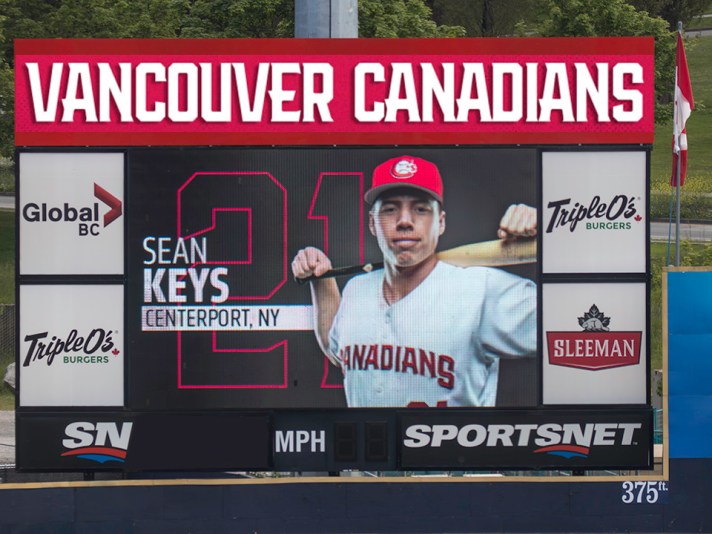
Sean Keys File
- Born – May 26, 2003, in Huntington, New York
- Height/Weight – 6-foot-2, 225 pounds
- Bats/Throws – Left/Right
- Walkup Music – “Back in Black” by AC/DC.
- Uniform Numbers – Wore number 20 with the Bucknell Bison from 2022-2024. Wore number 15 with the Westhampton Aviators in 2023 and 2024. Wore number 17 with the Cotuit Keetleers in 2023 and 2024. Wore number 8 with the Dunedin Blue Jays in 2024.
- Professional Debut – August 7, 2024, for the Dunedin Blue Jays at Palm Beach Cardinals.
- First Professional Hit – August 7, 2024, for Dunedin at Palm Beach. RBI single in second at-bat against Jason Savacool.
- First Professional Home Run – August 15, 2024, for Dunedin at Bradenton Marauders. Two-run homer vs. Clevari Tejada.
- C’s Debut – April 4, 2025, at Tri-City Dust Devils. Drew walk in first Northwest League plate appearance against Austin Gordon.
- First C’s Hit – April 6, 2025, at Tri-City. Singled against Logan Britt.
- First C’s Home Run – April 11, 2025, at Spokane Indians. Homered against Jordy Vargas.
- Instagram – @seankeys_15
- Now You Know – Keys is the first position player from Bucknell to be drafted by the Toronto Blue Jays and the second overall. The Jays selected Bison pitcher Kyle Walter in the 18th round of the 2006 MLB Draft.
Thanks a million to Sean Keys and Canadians broadcaster Chris Georges for engineering this episode of C’s Chat.
Discover more from C's Plus Baseball | A Vancouver Canadians Blog
Subscribe to get the latest posts sent to your email.


 C's Plus Baseball | A Vancouver Canadians Blog