
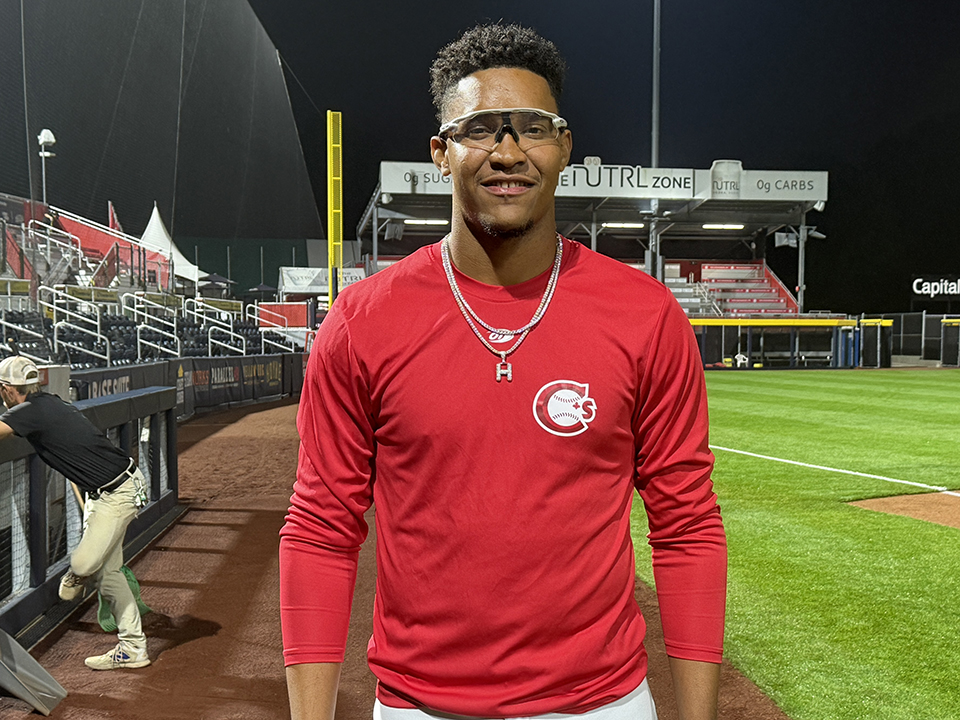
2025 Vancouver Canadians pitcher Silvano Hechavarría checks in for the latest installment of C’s Chat.

The Cueto, Cuba native was inspired to play baseball by his older brother Yadier Hechavarría, who pitched in the Cuban National Series (Serie Nacional de Béisbol, or SNB), that country’s highest level of baseball as an 18-year-old back in 2013. The righthanded-throwing Yadier spent three seasons with the Lenadores de Las Tunas, with a 2014 stint with the Cocodrilos de Matanzas in between. The elder Hechavarria recorded a career 13 saves and won six of 11 decisions with a 2.72 earned run average and struck out 90 batters over 129 innings.
Silvano would follow in his brother’s footsteps when he joined the Industriales de La Habana of the SNB as a 19-year-old in 2022. He pitched just 1⅔ innings in the 2022-2023 season but did not give up a run and struck out a batter over two appearances. Hechavarría saw more action on the bump in the 2023-2024 campaign and won his lone decision with a 4.25 ERA, finishing six games and striking out 24 batters over 42⅓ innings.
That helped Hechavarria gain an invitation from the Cuban Baseball Federation to attend a tryout to showcase his talents in front of scouts from Asia and the Caribbean. Eventually, the Toronto Blue Jays entered the picture and signed him as a free agent on June 7, 2024, giving him a signing bonus around $250,000, according to various reports. That money was surely appreciated by Hechavarría after telling Diario de Cuba the reason he wanted to turn pro was to help his parents financially.
Four days after signing, Hechavarría was in the Dominican Republic to join the Dominican Summer League Blue Jays for his debut. After a bumpy beginning in June, Hechavarría found his form in July by rattling off three straight victories to give him a 0.81 ERA for the month. After striking out 10 DSL White Sox batters in 5⅔ innings on July 16, he pitched seven innings of one-run ball against the DSL Nats on July 23. Hechavarria finished the year with a 5-2 record, a 1.84 ERA and a 57/16 strikeout-walk total in 49 innings.
The 2025 season saw Hechavarria make his debut on American soil with the Florida Complex League Blue Jays. After four starts with a 1-0 record and a 2.12 ERA, he was promoted to Dunedin. After a 3.38 ERA over 21⅓ innings in June, Hechavarria heated up with the D-Jays in July. He won his first High-A start with six scoreless innings and five strikeouts against Tampa on July 22. He gave up just one run in July and strung together a scoreless streak of 17⅔ innings to end the month.
Hechavarria said goodbye to Dunedin and hello to Vancouver when he was promoted on August 12. He won three of his four starts with the C’s, including a successful debut in Spokane on August 16. Hechavarria also got the win in his maiden voyage at Nat Bailey Stadium, pitching 6⅔ scoreless stanzas of two-hit ball in a victory against Tri-City on August 22. He punctuated his season with another win at The Nat against Everett with two runs allowed and seven strikeouts on September 3. In 22⅓ innings, Hechavarria posted a 3.22 ERA with the C’s and struck out 19 batters against eight walks.
MLB Pipeline ranked Hechavarria as the 25th-best prospect in the Toronto Blue Jays system.
“Hechavarria stands at 6-foot-4, bringing plenty of mound presence, and throws from a high release. His four-seam fastball touches 96-97 mph and is generally 93-95 with good carry out of the high slot and some armside run to boot. He’ll mix in a sinker variety around the same velo too for a different look. An upper-80s slider actually acts as his primary weapon. It’s a tight offering with less than an inch of gloveside movement on average and tunnels well off the heaters until it’s too late, diving below bats. It gets a ton of whiffs against lefties, helping Hechavarria run severe reverse splits.
The righty also sports a mid-80s changeup that can get too firm and is pretty hittable in the zone. Because Hechavarria doesn’t have wild movement, he can spot his pitches well, both for called strikes and to elicit chase. He’s already the age of an American college senior, so he needs to be challenged soon and prove he can work deeper into games to become a split-proof backend starter in the bigs.”
Where Hechavarria will pitch in the Blue Jays system in 2026 is unknown at this point. He may be back in Vancouver or the Jays brass may decide to send him to Double-A New Hampshire. His next competitive pitch will be thrown at the 2026 World Baseball Classic as he will represent Cuba in Puerto Rico from March 6-11. As fate would have it, Hechavarria and his Cuban teammates are in Pool A, which includes Canada, the country where he finished his 2025 campaign.
C’s Plus Baseball chatted with the 22-year-old Hechavarria with translation provided by Domingo Guarenas one day after his final start of the season against Everett. This interview has been edited for clarity.
C’s Plus Baseball – Silvano, you’re from Cuba. How did it all start for you? When did you start playing baseball?
Silvano Hechavarría (translated by Domingo Guarenas) – I never actually started to be a baseball player. I started following my track and field dreams in Cuba, but then I actually followed my brother (Yadier Hechavarría), who was a baseball player. Instead of training to be a track and field star, I started playing baseball and that’s how everything started.
CPB – How far did your brother go in his baseball career?
SH – He didn’t actually go very far in terms of the professional side of things but he was actually a part of the Cuban National Team a couple of times but he wasn’t able to sign with a professional team. It just didn’t really work out for him.
CPB – Talk about some of the teams you played for before you signed with the Blue Jays. Who did you play for?
SH – I played for the Industriales which is one of the main teams in Cuba. But then things didn’t really work out the way that I wanted it to. I had to actually go through Haiti and then from Haiti to the Dominican Republic. In the Dominican Republic, I basically did my due diligence and I was able to actually sign a professional contract and then I played my first year in the Dominican League. Then from there to Dunedin and then from Dunedin to where we are right now.
CPB – When did you first start pitching? I know usually most players, they begin playing in the field but when did you take up pitching full time?
SH – I started when I was a kid because I had no fighting chance to actually hit a baseball. So I had to follow my brother’s advice, he was a pitcher as well. So I fell in love with pitching. I did it day in and day out, and that was my way to get ahead and I absolutely love it.
CPB – Talk about how you signed with the Blue Jays. Who scouted you and who got a hold of you, did all the signing and all that. How did that all develop with you signing as a free agent with the Blue Jays?
SH – It took about five months, give or take. My agent took care of everything. He definitely did everything he could to take care of me and actually make the signing work out. I played basically four months in the Dominican Summer League to actually make the adjustment there and then basically after the four months, I got the promotion when I was actually able to get my visa and come over to the States.
CPB – Do you know who got a hold of you or who was the scout that was involved in getting you signed with the Blue Jays? Who was instrumental in that?
SH – It was actually kind of an organization thing, it was not just one person, it was kind of like a group of people that actually work as a team. There was not just a specific person that helped me out to kind of get to that level but it was kind the whole organization of people that actually get that over the hump for the Cuban people.
CPB – Who helped you develop as a pitcher?
SH – I can actually kind of point out one (person), Pichardo (strength and conditioning coach Napoleon Pichardo, now with Texas), who was one of the biggest people in terms of the Dominican (staff). I have to say it was one of those things where I kind of took a little bit from everybody that I’ve actually worked with and make sure I absorbed as much as possible to get to the next level.
CPB – You started off with the Dominican Summer League Blue Jays before making your way over to the States. How big an adjustment was that for you? Obviously you moved from Cuba to the Dominican but was that like going to the States to pitch?
SH – It was a really, really kind of weird adjustment. Especially not being able to express how I was actually feeling and what not. So it was actually very hard for me to get my message across. But as the days go by and the weeks go by, it was easier for me. I was actually liking the way things went and liking the routine. And even though I’ve been here only for three weeks, I absolutely love it.
CPB – I know the Jays have had some Cuban players, like Kendry Rojas. Who else have you really connected with as far as being in the Blue Jays organization? Who did you just get along with right away?
SH – The three Cubans that have actually been here with the Canadians, Rafael Sánchez, Lazaro Estrada and Kendry Rojas. Not only from the mental part of it because I mean throughout this whole process, mentally I’ve been a little bit down but I’m kind of getting used to things. But they have actually called me time and time again to make sure that I stay with it, trust the process. And not only from the mental side of it, but also in terms of the grip of the pitches. Make sure that they adjust with my splitter and so on and so forth. But I have to say the biggest impact has been Rafael. It’s been a higher level, but I’ve always been there for him.
CPB – I want to talk about what you throw. What are the pitches that you throw right now? You mentioned the splitter, but can you just run down what you are throwing?
SH – I have only three pitches, the slider, the fastball and the split. Right now, I’ve been falling (behind) with the splitter. Even though it was not exactly the most efficient kind of pitch when I started. Now I completely fell in love (with the pitch) and I’ve been working really hard on it and I love every single one of (my pitches). But I have to say the splitter is my signature pitch.
CPB – Did you figure out how to throw the splitter by yourself or did you someone teach you how to throw a splitter?
SH – It was definitely not a personal decision. I definitely spoke with Rafael and he was able to guide me through it and make that as a weapon. Not so much as just an extra pitch, but the weapon to actually get people out. And then I actually showed the brass of the Blue Jays and they actually liked the way the movement of the pitch was working. And I stayed with it, and now it’s actually one of the weapons that actually control my repertoire.
CPB – I wanted to ask about your fastball. Is it just a four-seam that you’re throwing or is there another kind of fastball that you throw?
SH – Even though it’s a fastball, I actually focus on a two-seam fastball. Until they actually hit me and they tell me I have to change it, I’ll be throwing the two-seam fastball. I don’t throw a four-seam fastball because obviously there’s a little bit more run on the two-seam fastball. But the two-seam fastball is the only fastball that I’m focusing on right now.
CPB – I wanted to ask about the slider. Did anyone teach you a grip for that or was that something you developed on your own?
SH – In terms of the slider, that was a natural pitch that came from me. I had it even when I was a pitcher in Cuba. It was actually something that I had to refine day-in and day-out, especially through the offseason but it something that came naturally.
CPB – What is your battle plan when you go and pitch on the mound? What is it that you’re hoping to accomplish? Do you have a certain philosophy or a certain way of how you attack hitters?
SH – I used the approach that my Dad (Silvano) gave me when I was a kid in terms of ‘Don’t think you’re better than everyone else, but believe that you are better than who you are facing,’ which kind of changes the mentality of things. (Following) my brother and in following Pedro Martinez, (just) being aggressive when you are facing the hitters and make sure you stay on top of the counts and being aggressive all the way through. I make sure that before I jump out of the dugout, (I tell myself) ‘I can do it,’ and ‘Go for it’ and be aggressive all the time.
CPB – You had a terrific season with Dunedin. What was the key to your success?
SH – There were two main things that actually made a huge difference. (Consistency) and routine was absolutely key. When I was actually in the Dominican and actually developing going into Dunedin, there was no routine. There was not a set plan across the board. But one of the things they did in the Dunedin camp when I came and what promoted me to Vancouver was that consistency part of it, the routine aspect of it, and the mentality that it’s never going to change. You’ve got to do your work, you have to put your work in, and the routine is what’s going to get you to the next level.
CPB – The Player Development Complex in Dunedin. How did that help you develop as a pitcher?
SH – Well, the key thing is actually the difference between going from Cuba when you basically hadn’t anything, it was like bare bones, to have pretty much every single technology available at your fingertips. The ability to watch my videos day in and day out and actually be mesmerized about the things that you can actually do and you cannot do. And being able to focus on those things on video and also rely on the people that know the technology and give me the information that I ask from them when I’m developing. That’s been absolutely critical for my quick development in the complex.
CPB – I wanted to ask how you found out about getting promoted to Vancouver. Was there a story with that? Who told you? How did you find out?
SH – It was absolutely funny because the day I got the news, I had a horrible outing, I felt horrible. My stuff was actually not working. I worked two innings and it was actually one of the poorest outings that I had. And then when I went into the clubhouse, they had a meeting. And one of my teammates (Austin Cates) got the call that they were going to Vancouver. I’ve always been a team player and I was really happy for him. And all of a sudden, they called my name. And I was like, ‘Wow! What? Did I do something wrong? What’s going on here?’ And then I kept asking, going back and forth, ‘What? What? What? I’m going to Vancouver? What’s going on here?’ So it was definitely one of those days. When you least expect it, good things actually happen.
CPB – I wanted to ask about pitching here in Vancouver. Is it a big adjustment from pitching in Dunedin? Obviously, it looks like this is a pitcher’s park here in Vancouver. How have you enjoyed pitching here and how different is it from Dunedin?
SH – Actually, one of the things that’s kind of funny that way is every league that you play, it’s going to be hard to actually be a pitcher. I don’t really focus on the fields themselves, I focus on the hitters. And one thing that I’ve actually noticed here that I had to make the adjustment on the fly is that there were a lot of free swingers in Dunedin. So you were able to get away with more stuff. Here, unless you throw it in the strike zone, people are not going to swing at the pitch. So you have to be a little bit more fine and be more refined as you develop. The hardest league that I actually had to adjust to was the rookie league because even though it’s a lower level, there were more Latin players that just want to put the ball in play. So even though they’re not looking (to) hitting the ball out of the park, they’re looking for contact. So you had to kind of be a little bit more aggressive when attacking the strike zone.
CPB – We’ve seen you win two games here in Vancouver. Your reaction to the fans, you tip the cap to the fans. We don’t see pitchers always do that. Have you always done that? It’s kind of a nice thing for the fans. Obviously, you connect with the fans but is that something you’ve always done after a good start like that?
SH – It all started in Dunedin. People started cheering. Basically, acknowledging my good work and all the work that I’ve been putting together. It was my way to actually show them respect every time I put in the effort. They actually showed that support day in and day out. Obviously, when you come here, the key thing for me has been that the people here in Vancouver have made me feel like a family. They’ve embraced (me) every step of the way. Because I feel like family and they cheer for you, I want to actually acknowledge the fact that I enjoy when they actually cheer for me. It’s respect and saying hello and saying thank you to them. I tip my hat every single time that I come off the mound.
CPB – How do you enjoy pitching in front of the bigger crowds here in Vancouver? I know they don’t get as many people in Dunedin. They do have a loyal gathering, but not to the extent of here. What’s it like pitching in front of bigger crowds?
SH – It’s absolutely beautiful, but it’s something that I try not to focus on. I just want to actually get out there and do my work. Get my outs and throw the pitches that I have to work on. But it’s absolutely beautiful to actually see the fans. Obviously, you find a way to acknowledge the crowd. Make sure that you’re absorbing the energy they’re providing for you. I definitely obviously try to acknowledge whether it’s with my hat or just saying hello to people. But I definitely focus on just getting my work done. I enjoy the energy but I’ve never been intimidated with big crowds. Obviously, playing with big crowds in Cuba, it’s definitely one of those things. I acknowledge it, but I don’t let it get to me.
CPB – Final couple of questions. I just want to ask. I think you said it was Pedro Martinez, but I just want to confirm. Did you have a favorite Major League player growing up and a favorite team?
SH – In terms of like how I adjust, in terms of like a role model of what I aspire to be, obviously Pedro Martinez is definitely the role model I want to be in terms of the attitude and the way he went about his business. A lot of people actually say that I pitch like Sandy Alcántara of the Marlins. But I also like attitude of like Marcus Stroman, who actually pitched here. But at the end of the day, I just want to make sure that I have the same mentality and approach that Pedro Martinez has. And of course, the Blue Jays are my favourite team.
CPB – Final question. The Canadians have lots of different uniforms. Red, black, blue, grey, white, the lumberjack. Do you have a favourite?
SH – I have to be absolutely honest. I like the retro uniform but I have an ulterior motive why I like it the most. It’s because the hat has the colours of my flag. So it was kind of my way to pay homage to my country and kind of be able to wear the colours of my country even though I cannot wear them officially. But I had a way to kind of honour that and actually wear the colours of my flag.
Silvano Hechavarría File
- Born – March 18, 2003, in Cueto, Cuba.
- Height/Weight – 6’4”, 227 pounds
- Bats/Throws – Right/Right
- Uniform Numbers – Wore number 37 for the Dominican Summer League Blue Jays in 2024. Wore number 48 for the Florida Complex Blue Jays, number 16 for the Dunedin Blue Jays and number 32 for the Vancouver Canadians in 2025.
- Professional Debut – June 11, 2024, for the Dominican Summer League Blue Jays at DSL Arizona Diamondbacks Red.
- First Professional Strikeout – June 11, 2024. Struck out DSL Arizona Diamondbacks Red Gian Zapata swinging.
- First Professional Win – July 16, 2024, for the DSL Blue Jays vs. DSL White Sox. Pitched 5⅔ shutout innings and struck out 10.
- C’s Debut – August 16, 2025, at Spokane.
- First C’s Win – August 16, 2025, at Spokane. Allowed two runs and struck out five over five innings.
- Instagram – @hechavarriajr
- Now You Know – Silvano hopes to be the second Hechavarria to play for the Toronto Blue Jays. Shortstop and fellow Cuban Adeiny Hechavarría played for Toronto in 2012.
For video evidence of this chat, please click here.
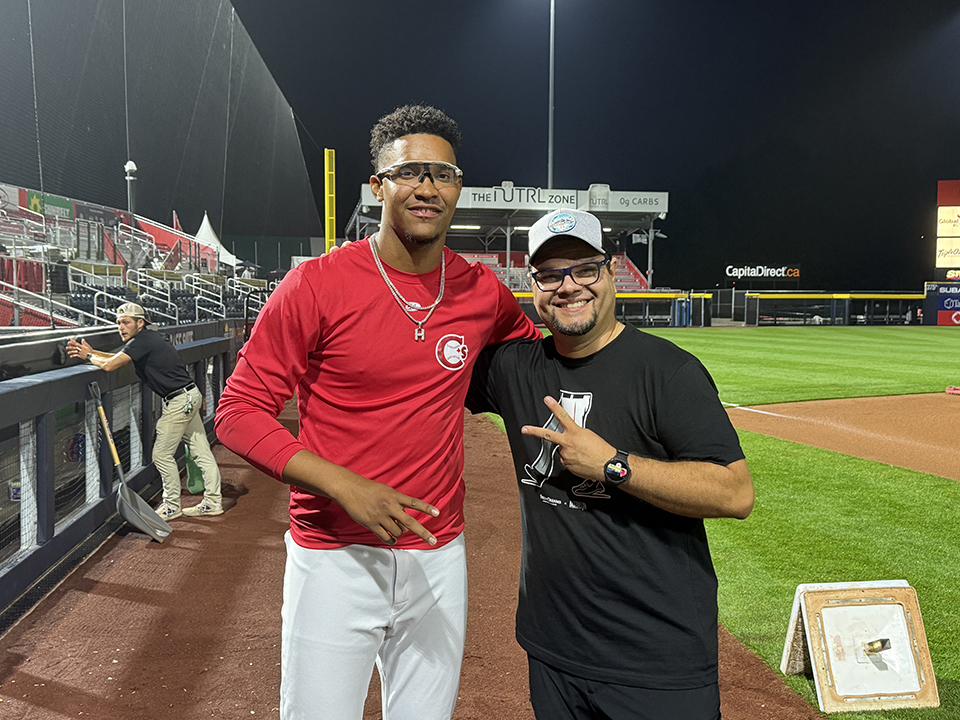
Un million de gracias to Silvano Hechavarria, translator/Home Plate 33 podcast host Diego Guarenas and C’s broadcaster Chris Georges for their role in getting this C’s Chat on the world wide web.
Discover more from C's Plus Baseball | A Vancouver Canadians Blog
Subscribe to get the latest posts sent to your email.


 C's Plus Baseball | A Vancouver Canadians Blog