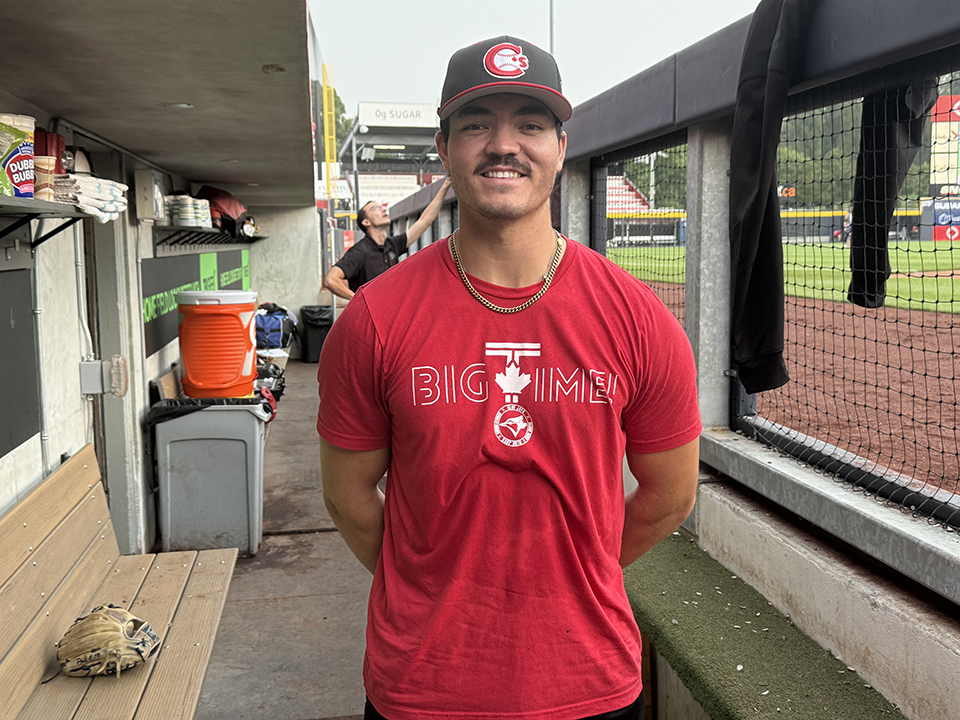
2025 Vancouver Canadians second baseman/left fielder JR Freethy leads off our C’s Chat series in 2026.

John Reagan Freethy was born in Walnut Creek, California, located in the San Francisco Bay Area. He was raised in Rocklin, CA and attended Granite Bay High School in Granite Bay, about 25 miles northeast of Sacramento. Freethy put together a stellar 2019 campaign for the Grizzlies, hitting .425 with 37 hits to lead the Sierra Foothill League and earn Team and Offensive Most Valuable Player honours. After a COVID-shortened 2020 in which he had two hits in four at-bats, Freethy batted .478 with 32 hits in 22 games and stole 13 bases as a senior in 2021. Those seasons highlighted a baseball resume which also saw him help his travel club win the Arizona Fall Classic Championship in 2017.
Freethy attended the University of Nevada in 2022, but an elbow injury limited him to just eight games during his freshman season in Reno. He headed to the Pacific Northwest that summer to join the Bellingham Bells of the West Coast League to make up for lost time. In 2023, Freethy batted .255 in 40 games with the Wolfpack and was named the Mountain West Conference Player of the Week on April 18 when he batted. 538 in four games against Air Force. He followed that up with a sizzling summer session with the Macon Bacon of the Coastal Plain League in which he posted a batting line of .287/.374/.478 (AVG/OBP/SLG) with six doubles, four triples, four home runs, 25 runs batted in and seven stolen bases in 34 games.
Freethy’s time in Georgia was the springboard to a strong 2024 campaign with the Wolfpack. His .994 OPS in 51 games was 238 points higher than his sophomore campaign and he drew more walks than strikeouts with a 35-31 total. Freethy racked up 31 extra-base hits, including 10 home runs, with his most memorable being a walk-off homer against the then-ranked number 4 team in the country Oregon State on April 17.
On the recommendation of scout Ryan Leake, the Toronto Blue Jays selected Freethy in the 14th round of the 2024 MLB Draft and he would get a signing bonus of $150,000. That put an end to Freethy’s original plan to transfer to the University of Georgia in 2025. Instead of going to Athens, he got in a 20-game cameo with the Dunedin Blue Jays and continued to maintain a strong batting eye with 17 walks against 18 strikeouts, leading to a .408 on-base mark. Freethy was also successful in all four of his stolen base attempts. His first home run was an inside-the-park effort to drive in the winning run in the 9th inning against Tampa in his third-last game of the season.
Before being assigned to Dunedin again to start the 2025 season, Freethy made his spring training debut for the Toronto Blue Jays with a pinch-running appearance on St. Patrick’s Day. He continued to get on base at a healthy clip with a .408 OBP into early May with the D-Jays before being hit in the face with a line drive to center field in a game against Dayton on May 4. At the time of his injury, Freethy was tied for first in the Florida State League with 21 runs scored and was second in the circuit with 22 walks. He would miss the rest of May and the early part of June before returning for a rehab stint with the Florida Complex League Blue Jays. After recording a .375 OPB in 10 games there, Freethy returned to the D-Jays and started to raise his batting average by hitting .281 in July. With a slash line of .252/.404/.307 in early August to go along with 11 extra-base hits and 17 RBI in 46 games, he was promoted to Vancouver on August 4.
It did not take long for Freethy to settle in at the High-A level. He had two hits in his debut game against Hillsboro on August 6 and would win the Northwest League Player of the Week award for August 11-17 after a dominant six-game stretch in Spokane that saw him hit .458 with a home run among seven extra-base hits and he drove in eight runs. The standout performance of that series was Freethy reaching base all six times with two doubles, two singles and two walks on August 16. In 25 games with the C’s, he batted .252 with a .383 OBP, one home run and 10 RBI and was rewarded with a late-season call-up to Double-A New Hampshire. Freethy ended the year with a bang by belting a three-run home run that included the game-winning RBI and adding a single against Chesapeake on September 14.
C’s Plus Baseball spoke with the recently turned 23-year-old Freethy during the team’s final homestand against Everett in September. This interview has been edited for clarity.
C’s Plus Baseball – JR, how did you get started in baseball?
JR Freethy – I started when I was seven. Grew up watching the Giants play. Both my parents grew up in San Francisco, so that was always on the screen and honestly, that’s what made me want to play, watching those guys play. So it started there. I went to Granite Bay High School and was kind of underdeveloped as a kid, you know, like undersized. So it was always something that I had to work for, like physically, and I feel like that’s part of who I am. I kind of play with a chip on my shoulder. Then I wound up at Nevada for my college career, and now we’re here.
CPB – How did you wind up at Nevada? Were there other schools that were interested or was Nevada just the right choice for you?
JRF – Yeah, it was close to home. There were other schools involved, but it just made the most sense. They gave me the best offer, close to home, liked the staff there and thought that was the best option.
CPB – Before you arrived at Nevada, I read that you’re a part of a championship with a travel team. What was that experience like?
JRF – Yeah, it was actually a guest team I played for. It was like my freshman year, I think. So it was really me and like three of my best friends. So it was super cool and then you had people from all over playing in that. So it was the Arizona Fall Classic, that’s what it was called. But yeah, it was super cool. Like all three of us ended up pitching the championship game. Something you don’t see every day, but it was a great experience.
CPB – I know it’s usually the case that lots of players are two-way players but what did you mostly play in high school?
JRF – Yeah, in high school, mostly just shortstop. But I’ve always kind of grew up playing like all the positions. So I played outfield growing up, played infield. Something I want to keep part of my game, for sure.
CPB – Any memories that stand out for you in high school when you look back at your time at Granite Bay?
JRF – Yeah, there’s a ton. I think we just had a really good group of guys, good coaching staff. I still am in contact with them and I see them every offseason. So yeah, it was cool. I grew a lot there, learned about myself, learned the game, and just had some awesome memories.
CPB – So you went to Nevada. How did that help you develop as a baseball player?
JRF – You just learn the game so much more. Like once you get to college, the game speeds up, you know? Whether it’s pitching or time in between pitches, right? Like you have to know the situation, you have to figure out how to catch up to velo, read shapes as a hitter, all that stuff. So I think I developed a lot physically and also mentally, too. Just being able to play the game pitch to pitch is something I really learned in college.
CPB – Who would you say has helped you develop as a player, either in high school or in college, to help you get to this point here today?
JRF – Noah Brewster was my hitting coach. He also works with Scott Templeton and those two guys I’ve worked with since I was like nine years old. So they also kind of taught me the game right at a young age, which I feel is really important as you’re developing. And again, I’m still in contact with those guys and I’ll see them and hit with them in the offseason. So those are two of the first names that I could think of. But then it’s everyone you come across, you know, from Little League all the way to your time in your pro career. You just learn so many different things, so many different angles of the game. I can name probably a hundred people. It’s always not just one person.
CPB – I wanted to ask about your time in Nevada. What was that like playing in the Mountain West Conference? I went to one game at UNLV a few years ago. The one thing I noticed, the ball just flies out of that park. Was that really more of a hitting conference there?
JRF – Yeah, definitely a hitters conference. Games would be long. Some would be blowouts. You’re seeing a lot of double-digit run games. You got to stay locked in for all nine (innings) or more for that. But definitely a fun place to play. Fun conference. And, you know, good hitters. So it’s cool to be a part of that. It’s cool to learn and take things from other guys there. It’s your competition, so it gets you better. But I think it’s a good all-around conference. I think it’s only getting better just from the way I’m looking at it now. But definitely a boom box up in Nevada with the elevation, too. So that’s definitely something I miss.
CPB – One player who was in your conference, Austin Cates, who you had a chance to face at UNLV. What was that rivalry like with Nevada and UNLV?
JRF – We tried to not make it too big of a deal. Jake McKinley, who coached me the last two years in Nevada, was really big on that. Just, you know, it’s another series and that’s kind of how we looked at it. And that’s, I think, how you play your best baseball without getting emotional about the series, right? But there’s still always going to be tension there. And, yeah, we faced Cates. And, yeah, he was pretty nasty. But I got him in spring training, so that’s what matters.
CPB – Nice. Okay, I wanted to ask about summer ball experiences. It’s not your first time in this neck of the woods here with the Bellingham Bells. And a couple other stops as well, including the Macon Bacon. That’s one of the great names of baseball. Talk about your summer college experiences and what you took away from there.
JRF – Yeah, it’s always good. I think summer ball is great. You just get more reps in, right, that maybe you missed during the season. So after my freshman year, I was hurt. So I didn’t really play. And then I was able to get those reps back in Bellingham, which is cool. It was a struggle because I went nine or so months without seeing live pitching or something like that. But it’s good. There’s value in that. And that allowed me to grow as well. Georgia was really fun too.
CPB – You mentioned your freshman season and your injury. Can you talk about what happened?
JRF – Yeah, it was before I got to college. It was a UCL tear. So I got the brace and repair on it and that just took some time to recover. But yeah, I’m back now.
CPB – It’s never great to get an injury, but I guess the blessing is you weren’t a full-time pitcher where you would have been sidelined longer. What was the recovery process like for that?
JRF – It was just a lot of rehab and consistency with that. That was also something I had to learn is showing up every day and crossing the boxes off the list that you need to get done in rehab, which kind of helped keep me disciplined in that area. But yeah, I took around eight to nine months for me, which isn’t as bad as it’s usually longer for pitchers with the full surgery. But yeah, I think four months in, I was able to start swinging the bat. So yeah, not terribly long before I could do anything.
CPB – Just want to touch upon your season again in Macon. You had a really good year there. What was that like playing there on the other side of the country?
JRF – It was amazing. We had an awesome host family, which I feel like makes or breaks your summer, really. They providing us food all the time. I mean, they’re just always there for us. And the environment was super cool, you know, pretty historic field. Used to be a minor league park (Luther Williams Field). A lot of historic names played there. Very humid, but it was worth it. A ton of memories that I made on and off the field and pretty good competition. So I feel like I definitely got better there.
CPB – You get drafted by the Blue Jays. What was that draft day experience like for you?
JRF – I was just at home. I think I was eating a sandwich that I just made. And I wasn’t really looking at the tracker, but kind of just waiting on a call from someone. I had an idea I was going that day and then my agent told me to watch out for the Blue Jays, whatever that meant. Didn’t really know what that meant, but then my Mom started yelling in the other room. She was getting excited. I wasn’t looking at the tracker, but it was a pretty cool moment. She came in, we hugged, and it was awesome. I actually had to call my Dad because he went to the gym. He couldn’t really handle the stress of that day. I had to call him. He came right back home so it was a surreal moment for sure.
CPB – Did you have an idea what’s going to be the Blue Jays or did you think it was going to be another team?
JRF – There was a good handful of teams in the mix. I really wouldn’t have guessed that it would be the Blue Jays, but I did go to one of their camps that summer so they were in the mix.
CPB – You get to go through draft camp. What was that like getting through the draft camp experience? How did that help you get indoctrinated into pro ball?
JRF – It was really cool. They kind of laid out the foundation and the expectations for us, which is really important. I think the biggest thing is, you know, you get from college to here, you’re playing more than double the amount of games you’re playing in college. So the biggest thing is they’re really big on prep and recovery here, which is a really big difference. It’s important and it pays off. Just hammering the little details and being consistent is like something you definitely learn when you get here.
CPB – Was there anyone you hit it off with right away, either players or coaches?
JRF – Yeah, me and Eddie Micheletti. We got pretty close. And then Tucker Toman, another switch-hitter. So we have a lot in common. Two good guys.
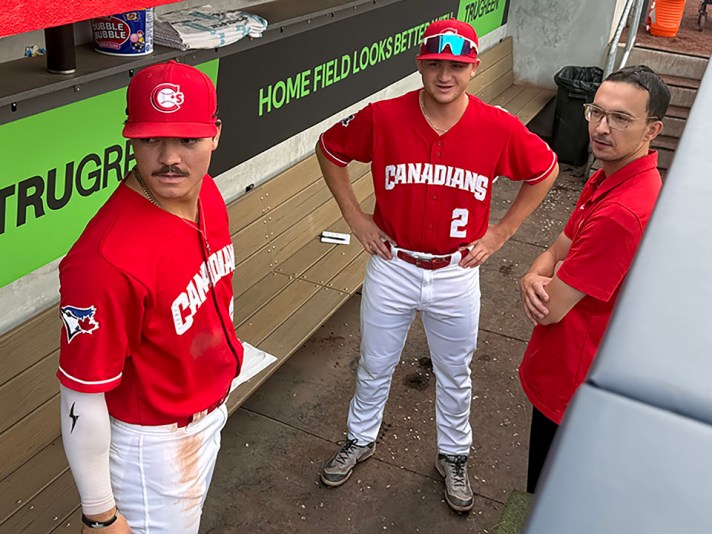
CPB – Thank you for segueing into switch-hitting. Were you always a switch hitter or when did that all start for you?
JRF – Yeah, pretty much, I mean, when I was seven. That’s when I started practicing it. I just grew up watching Pablo Sandoval on the Giants and I thought it was the coolest thing ever. So I just wanted to try it and it became part of my game.
CPB – Did you have a natural side or what’s your more comfortable side?
JRF – Yeah, I started (as a) lefty. That was the first swing I ever took off a tee, but I kind of do everything different. Like I write lefty, but throw righty, kick righty. I can’t really tell you what the dominant side is there.
CPB – How do you go about making sure both swings are where you want to be?
JRF – It’s all about how I’m feeling really that day or that week. It depends on who’s pitching in that game. So if a team is pretty right-handed heavy, I’m gonna obviously take more swings from the left side and then, you know, if they have a lefty starting that day, I’ll make sure to get more work in right-handed. So it’s a day-to-day thing and then kind of how I see fit based on how it’s feeling.
CPB – You mentioned Tucker Toman being a switch-hitter as well. Do you guys bounce ideas off each other?
JRF – All the time, yeah. Because, you know, we go through the same struggles as switch-hitters. It’s tough enough with one swing, but with two, you really got to stay on it while managing the workload, right? Because you don’t want to do too much and end up hurting yourself or limiting yourself. So we kind of bounce ideas off each other, you know, like maybe two rounds from the right that day and the rest from the left. And flip-flop that maybe, depending on the pitcher.
CPB – I guess there’s statistically more right-handers than left-handers so it’s more of a challenge trying to maintain that right-handed swing.
JRF – Yeah, yeah, definitely. Luckily for me, I feel like my right-handed swing usually just needs a few tweaks to get it going, whereas the routine’s a little bit longer on the left-handed side to get it going. So it’s kind of a blessing there.
CPB – What is your approach when you step into the batter’s box? Do you have certain keys that you kind of think about, or is it just basically “see ball, hit ball”?
JRF – Yeah, I wish it was just see ball, hit ball. That would probably be a lot easier, but there’s a little bit more elements that go into it, depending on the pitcher. I mean, the approach that works best for me is usually just being on time for the fastball. You know, I trust my eyes a lot. I feel like that’s part of my game, too, is swing decisions. So usually if I’m on time for something in my zone, I’ll lay off the other pitches and get mine when it’s there.
CPB – Certainly the one thing that jumps out of the stat page when we look at your stats, the on-base percentage, it’s been in the .400 neighborhood. How were you able to develop such a good batting eye?
JRF – It’s mostly, I would say, natural ability. Since I was a young kid, like, BP (batting practice) throwers didn’t like throwing to me. Like, my coaches would get mad at me because I’d only swing at the good pitches, right? Like the strikes. So I think it’s always kind of been there. But you know, you learn to see shapes and different spins, and I think that’s something, like I said, in college you definitely learn as well. So that only gets it better, and I think that’s just added to my game there.
CPB – You started off with Dunedin in your first pro season. How did you feel it went?
JRF – I mean, I got on base a lot, didn’t do as much damage as I wanted to, so that was a big thing this offseason going into this year, was to get those damage numbers up. And yeah, I felt like it was a little bit of a struggle at first, but I was still able to do some things really well, but definitely like a learning moment for me, so I think it was a really valuable experience to go through.
CPB – The Player Development Complex, I’m sure you had a chance to go and see all the bells and whistles. How did that help you develop as a player?
JRF – It’s got everything you need. All the cages, there’s always someone there to help you. Incredible weight room. The food, food is a big one. You know, guys like me love to eat and get the nutrition in. And then from a recovery standpoint, they have everything. So we’re provided all the resources and it’s up to us to take use of them.
CPB – The Trajekt machine. I’ve heard that it simulates Major League pitchers. Is there a pitcher you choose that you work out with? I heard Gerrit Cole‘s available.
JRF – Who did you put yourself up against? I’ve gone with Cole a few times. A bunch of different guys like (Shohei) Ohtani. I don’t know if I’ve thrown (Aroldis) Chapman on there, but I mean, it kind of all depends on what we want to see that day and what we want to work on. So we’ll find a pitcher that kind of matches that, you know. If we want to see slider spin or changeup spin, it will kind of depend on that.
CPB – How cool is that to see something like it’s almost as good as the real thing?
JRF – It’s awesome for development purposes too because you don’t really get to hit off a pitcher unless you’re playing in-game. So to be able to do that off the field is, I feel like, super important and it’s a huge advantage to have as a hitter.
CPB – You return to Dunedin for 2025 and eventually get the call to go to Vancouver. How did you find out about it? I know sometimes the manager likes to have a little fun with the players before telling them the news, but what was that like for you?
JRF – Yeah, it was cool. It was after a Sunday game. So our manager Gil Kim just pulled us all into the room for team meeting and basically just at the very end said none of the scheduling applies to me for the next week because I’ll be in Vancouver. So it was a pretty cool moment. Yeah, super exciting and I’ve been excited to be here.
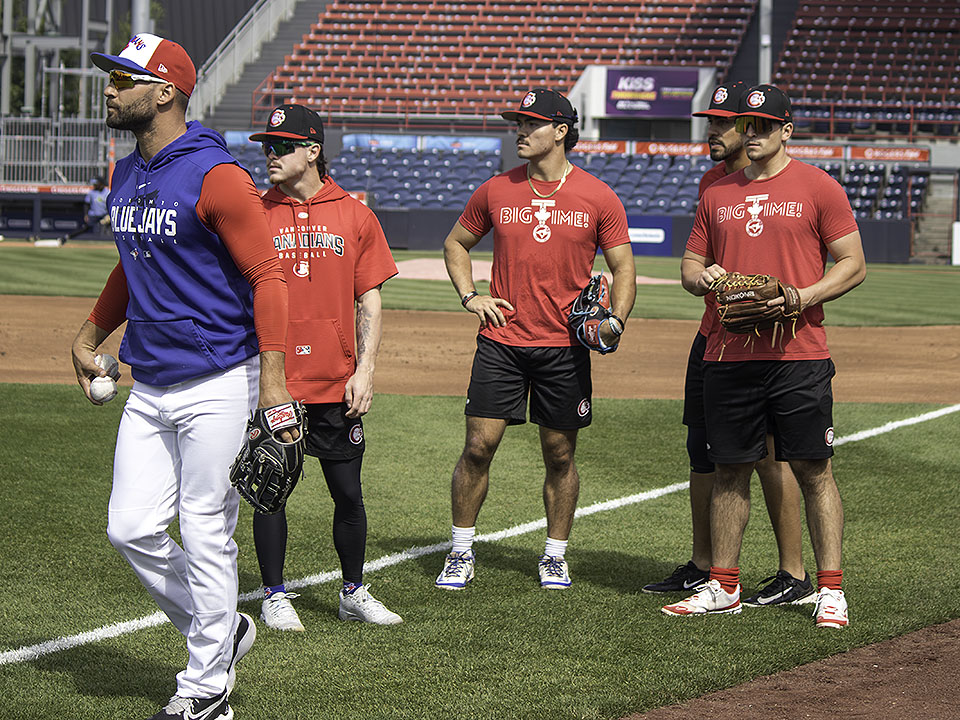
From left to right – former Toronto Blue Jays Kevin Kiermaier and Vancouver Canadians outfielders Bryce Arnold, JR Freethy, Alexis Hernández and Eddie Micheletti at Nat Bailey Stadium.
CPB – When you first got here, Kevin Kiermaier was here and I saw you were one of the guys who was taking instruction from him. What was that like meeting him and anything you took away from that visit? I’m sure he had a lot of advice to give, but what did you take away from that?
JRF – Oh man, a ton. We actually met him in spring training and I remember just his energy that he gives off. He loves the game and you can just feel it when he talks. He’s given us a whole bunch of different pointers, skill-based and mental-based in the outfield, which you really don’t get a whole lot as an outfielder. So it’s super refreshing to hear that and definitely gives you a defensive edge there. But the biggest one is just the focus element and bringing yourself, the best version of yourself to the field every single day. That’s what I got from it.
CPB – We’ve seen you at second base, we’ve seen you in the outfield. Do you have a preference? Because you looked really good at second base on a few plays there, but do you have a preference as far as where you play?
JRF – Yeah, I love the infield. I feel like taking ground balls is probably the most fun, but when you get action in the outfield, it’s really fun. So I’d say wherever the action is.
CPB – The week in Spokane, had a great week. Northwest League Player of the Week. You set the tone all six games. What do you remember about that week and why were you so successful?
JRF – Yeah, I think I was just keeping everything simple and really just trusting in my ability there and rolling with it. Hitting in that leadoff spot is really fun and it’s my job to get on base, but also do damage in situations where I need to and I feel like I capitalized on a lot of those opportunities.
CPB – What would you say has been your best moment with the team so far here in Vancouver?
JRF – That was a really good week. The team did really well too, so kind of being in those good team environments where we’re winning a lot is always good, but off the field too. Just when we’re enjoying food, it’s awesome. You get to learn your guys a little bit and kind of get to hear more than just baseball.
CPB – The adjustment from the Florida State League to here, has it been a huge adjustment? It seems like you made the adjustment pretty well, but have you noticed a huge difference from Dunedin to here?
JRF – Yeah, there’s a difference for sure. You see more consistent, better pitching. Guys are in the zone. Some guys down in the lower levels, they’re kind of spraying the ball and you can’t really tell if they have a plan up there. Whereas here, every pitcher has a plan, which for you as a hitter kind of helps at the same time because you can attack that plan and you can see how they’re trying to attack you. I’d say it’s more of a chess matchup here, which is fun and I’ve enjoyed it.
CPB – Playing here at Nat Bailey Stadium, obviously a few more fans than Dunedin anyway. Have you played in front of bigger crowds?
JRF – Yeah, I don’t know if I’ve played in front of more than the sold-out crowds here for sure. I’ve played in similar situations, but not often. Definitely a difference from Dunedin out there in the heat, but no, it’s been awesome. I remember the first day I got here, just feeling that excitement and the energy from the crowd.
CPB – You’ve mentioned that San Francisco Giants were your team growing up and Pablo Sandoval, your favourite player, but I wanted to ask, as far as leadoff hitters, was there maybe somebody else you really liked or tried to emulate?
JRF – Another switch-hitter growing up was Angel Pagan. I just really loved the way he played the game on both sides of the ball, offence and defence. He played hard and that’s the type of player I want to be, so that’s definitely a name I could put down in a leadoff spot.
CPB – Did you get to go to a lot of Giants games growing up?
JRF – I’ve been to a few, definitely could have been to more, but I feel like I went to enough to enjoy it and really be a fan.
CPB – Final question. The Canadians have lots of different uniforms—red, black, white, blue, gray, the lumberjack uniform. Do you have a favourite?
JRF – I kind of like the blacks, partially because they fit the best, but I love those ones. The blue ones are pretty sweet too. I like the throwbacks.
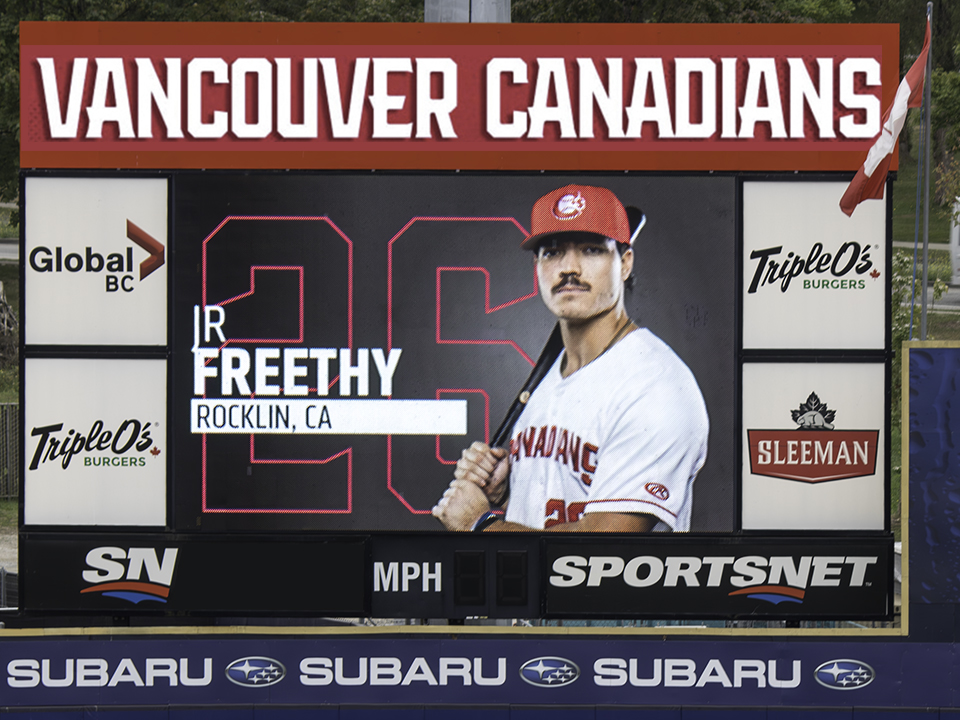
JR Freethy File
- Born – December 23, 2002, in Walnut Creek, California.
- Height/Weight – 6’0”, 215 pounds
- Bats/Throws – Switch/Right
- Uniform Numbers – Wore number 12 in 2022 and 2023 and wore number 9 for the Nevada Wolfpack in 2024. Wore number 9 for the Bellingham Bells in 2022 of the West Coast League and number 16 for the Macon Bacon of the Coastal Plain League. Wore number 14 for the Dunedin Blue Jays in 2024. Wore number 37 for the Florida Complex League Blue Jays, number 20 for the Dunedin Blue Jays and number 6 for the New Hampshire Fisher Cats in 2025.
- Professional Debut – August 7, 2024, for the Dunedin Blue Jays versus the Palm Beach Cardinals. Drew a walk against Jason Savacool in his first professional plate appearance.
- First Professional Hit – August 9, 2024, for Dunedin vs. Palm Beach. Singled against Chen-Wei Lin.
- First Professional Home Run – September 5, 2024, for Dunedin versus the Tampa Tarpons. Hit two-run inside-the-park homer vs Kristófer Bow in 9th inning to drive in winning run.
- C’s Debut – August 6, 2025, versus the Hillsboro Hops. Singled in first at-bat against David Hagaman.
- First C’s Home Run – August 15, 2025, at Spokane. Belted leadoff homer against Stu Flesland III.
- Walkup Music – “White Wine & Adderall” by The Chainsmokers, feat. Beau Nox.
- Twitter – @FreethyReagan
- Instagram – @reaganfreethy
- Now You Know – Freethy is the first Nevada Wolfpack player drafted by the Toronto Blue Jays since outfielders Jacob Butler (2005, 8th round) and Shawn Scobee (2006, 14th round).
- The More You Know – Lydell Moseby, the son of former Toronto Blue Jays outfielder Lloyd Moseby, attended the same high school as Freethy at Granite Bay High School and spent two years in the Jays farm systemafter signing with them as a free agent in 2013.
Thanks a million to JR Freethy and C’s play-by-play announcer Chris Georges for leading off the 2026 season of C’s Chat.
Discover more from C's Plus Baseball | A Vancouver Canadians Blog
Subscribe to get the latest posts sent to your email.


