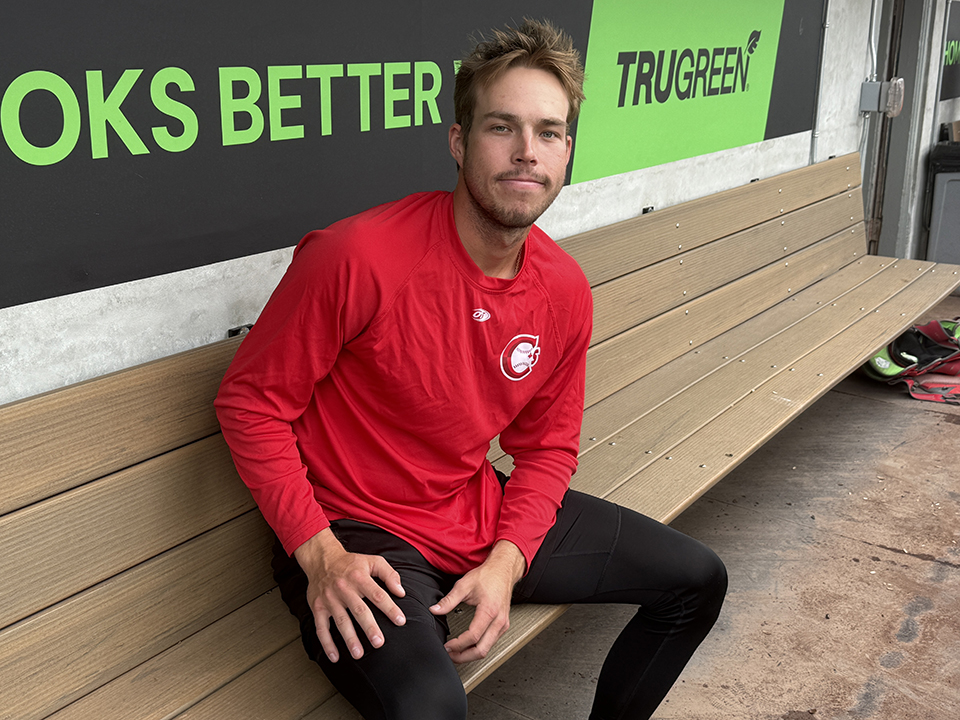
Covering all the bases with 2025 Vancouver Canadians utility player Peyton Powell in this edition of C’s Chat.

Born in Waco, Texas, Powell grew up in Robinson and was a multi-sport athlete at Robinson High School. He was a catcher, a pitcher, a shortstop and a third baseman during his time with the Rockets. Powell won his first five decisions over his freshman and sophomore seasons in 2016 and 2017 and batted .298 and .341, respectively, before hitting .495 as a senior in 2019. He was Robinson’s defensive MVP in his junior and senior seasons and a THBCA (Texas High School Baseball Coaches Association) Second-Team All-State selection in 2018 and a First-Team All-State pick in 2019.
It was in the fall of 2018 that Powell committed to the University of Texas and he would make the trek about 100 miles southwest from Robinson to Austin for his 2020 freshman. He would play just six games in the COVID-shortened 2020 campaign but batted .364 in a half-dozen games as the designated hitter.
Playing time was hard to come by for Powell in his first three years with the Longhorns, as he totalled just 30 at-bats in which he batted .300 with two home runs and four RBI. One big reason for the lack of playing time took place in his first stint of summer college ball with the Duluth Huskies of the Northwoods League in 2021. He batted .257 with a .358 on-base percentage, but his lone pitching appearance resulted in Tommy John surgery to his left elbow.
Fortunately, Powell did return to action for six games with Texas in 2022 and would enjoy a healthy stint in his return engagement with Duluth. He put up an OPS (on-base-plus-slugging percentage) of .808 in 28 games with a home run and 20 runs batted in and stole four bases in five tries.
That set the stage for a huge 2023 for Powell as he batted .339/.431/.508 with 16 doubles, one triple, 10 home runs and 46 RBI as the Longhorns third baseman. He was named to All-Big 12 Conference Second-Team squad for his efforts. In his final hurrah hooking up with the ‘Horns, Powell had nine homers among 21 extra-base knocks and compiled an .891 OPS to earn another All-Big 12 Conference Second-Team selection.
The Toronto Blue Jays, on the recommendation of scout Steve Riha, would sign Powell as a free agent on July 22, 2024. He started his pro career this seaosn with Low-A Dunedin and ended April with a .456 OBP in eight games, including a perfect night at the plate with two hits and two walks at Tampa on April 25.
Powell’s batting eye continued to stay sharp in May when he heard ball four five times and drove in a run against Daytona on May 2, giving him a .407 OBP for the month. To begin the month of June, Powell had a five-game hitting streak and seven hits in eight games, including his first professional home run as part of a three-hit game that was a triple shy of the cycle at Clearwater on June 19.
A .362 OBP over 53 games with the D-Jays led to a promotion to Vancouver for Powell on July 18. He reached base in six of his seven July contests with the C’s, including a three-walk effort at Tri-City on July 31. However, Powell’s early tenure will be remembered when he had to pitch against the Eugene Emeralds at Nat Bailey Stadium on July 24. After beginning the first game of a doubleheader at first base, Powell was pressed into service on the mound for three innings. Though he allowed two runs in his first inning, the C’s came back to tie the game in the ninth, and he would put up a pair of zeroes after that. Despite his pitches clocking around 57-68 miles per hour, Powell did get one swing and a miss and he would be credited with the win when Monty’s Mounties walked it off in the 11th.
With the leather, Powell has continued to display his versatility by appearing behind the plate as well as first base and left field with Vancouver. He also played those positions with Dunedin, along with one start at third base.
C’s Plus Baseball caught up with Powell during the team’s homestand against Hillsboro in August. This interview has been edited for clarity.
C’s Plus Baseball – You hail from the state of Texas. Talk about how did your baseball career got started?
Peyton Powell – Yeah, I started from a young age, playing a bunch of different sports, and baseball was the one I gravitated to the most, I would say. Growing up, playing select ball, Little League, going through the school systems of high school and stuff like that. I think my sophomore year of high school, I started getting college interest, so going into that was fun and it was a lot to take in too. Seeing those college names come across your phone and trying to give the coaches what they want, but also be yourself at the same time. But after that, going through those four years in high school, I ended up at UT, University of Texas at Austin, ended up going a full five years there with COVID being my freshman year. I had Tommy John my sophomore year from a summer ball incident, and then ended up playing my last two years at third base in the infield. Then I got the opportunity to get to sign with the Blue Jays this past year. Now playing infield, outfield, and catching, doing it all, so I’m just happy and grateful to be here.
CPB – You said you’ve played other sports other than the baseball. I know in Texas, football is huge, what else did you play?
PP – Yeah, I played football, basketball, soccer, track, but not too much track, but mainly basketball and football, liked those a lot, but I had to make a decision in high school to put those down and focus fully on baseball, if this is what I wanted to do for my career, so it’s worked out in that regard.
CPB – Were you a two-way player on the gridiron?
PP – Yeah, I was. I liked quarterback the most, that’s what I played on offence. I played linebacker or something like that for defence, but I really just focused on offence when I was playing football.
CPB – The University of Texas comes calling along, how did that all develop?
PP – It was super fast, honestly, I got invited to the Area Code Games (with the Texas Rangers Area Code team) going into my senior summer, and that’s when Texas saw me for the first time, and got in contact with me, and got my number and email and stuff like that. I think a week later I visited and then as soon as I left campus, I sort of knew that’s where I wanted to go. It was an amazing visit, it’s an amazing school, everything about it was so much fun, and I wouldn’t change a thing.
CPB – And you got to stay in your home state, so that was another bonus.
PP – Yeah, that was a big thing for me too, I’m a homebody, or I started out a homebody, but being up in Canada now, I’ve gotten a little bit better with it.
CPB – When you look back at your high school days, anything that stands out for you, special games or special memories?
PP – My very first high school varsity game, my freshman year, I remember hitting a walk-off, and so that was like a warm welcome, it was nice for me, like gelling with the older guys being the freshmen, so I remember that very clearly.
CPB – Now you were a catcher, you’ve been all over the place as you mentioned earlier but you spent time as a catcher, when did you begin catching?
PP – Growing up, a lot of guys were shortstops, mainly shortstop and third, and then my junior year, we had a couple older guys that were getting looked at for the draft and already committed to colleges. We didn’t have anyone that could catch them, so I was the best candidate for it, and it worked out in my favour, so I caught a couple years in high school. Then when I got to UT, I kept catching, but I played in the infield. So the same sort of deal here in pro ball, but now I’m actually playing catcher and infield and outfield, so I’m doing it all a little bit.
CPB – You spent basically parts of five years (at Texas), COVID had something to do with it, injuries as well, I guess that had to be a bit of a grind, but when you look back over your five years, how did that help you grow as a player?
PP – I think getting injured with Tommy John definitely helped the maturity process of me as a player. Before then I was, I’m not going to say that I was too quick to go on my own judgment or anything like that, but I think being forced to step away from the game and step back with an injury, and focusing on you and getting to really look at yourself from the outside. I think that was a big, big benefit for me, just maturing in my life, honestly, and then that translated to baseball.
CPB – You went to summer college ball with Duluth. I’m sure you were just hoping to get more playing experience, because I know the games played were a few and far between with the Longhorn. As you were talking about before, that’s where you got your Tommy John (injury), you were actually pitching and it was an emergency pitching appearance for you?
PP – Yeah, that was my first year in Duluth, in the Northwoods (League), we ended up pitching all of our infielders one game just later in the year, and just ignorant me back in the day, just kept saying I want to keep going, keep going, not understanding what was at stake, and that was my elbow at the time, but yeah, and so I requested to go back to the Northwoods because they play so many games, it’s the closest thing to a pro season, so I could get that new UCL broken in and trust it.
CPB – Just want to look back at your time at the Longhorns. The last couple of years, things really turned around for you. When you look back, what stands out for you when you think back on your time at the Longhorns?
PP – Oh my gosh, there’s so many things I could point and pick out, but I’d say the relationships I created with so many different teammates, the relationships I created with my coaches. Everything that I’ve learned mentally and physically, baseball-wise, that I can attribute. Just the last five years that I got to spend there, I’m just grateful to have done that, just to have that in my life and I’ve done that, I wouldn’t trade it.
CPB – How did you wind up with the Blue Jays, who got a hold of you?
PP – Steve Riha reached out to my agent, a couple minutes or hours, I can’t even remember after the draft happened. There were a couple of teams calling and we ended up working a deal out with the Blue Jays and going through the Bridge League after that, the offseason and then I started my year in Low-A, now it’s my third week in High-A.
CPB – The Bridge League, it’s not something that’s really highly publicized. The Florida Complex season was over by the time you got there, but what was that experience like?
PP – I think it’s just a way to get all the organizations to get their teams and their new players all on the field so you can get an eye on them in a controlled environment to where you can shut guys down if you need. You can say ‘Roll it,’ but I think it’s mainly for the new draft guys to get in there and just to get eyes on them.
CPB – So you got to draft camp, was there anybody you hit it off with right away?
PP – Yeah, Javen Coleman‘s from Texas as well, so me and him hit it off, and an old cat named Hayden Giilliland, that’s one of my golf buddies. So yeah it was good, them two guys, them two guys were good.
CPB – What was that draft camp experience like? How did that help you get used to the grind of pro ball?
PP – It was good meeting all the guys. Fortunately for me being in two Northwoods seasons in the past and going to UT, we practiced for pro ball seasons and stuff similar to that, so I had known what to expect. I also have a bunch of friends and past teammates in the organizations in pro ball, so I sort of knew that it was going to be a grind, but knowing that and being prepared for it helped for sure.
CPB – In the offseason, was there anything the team told you to work on heading into 2025?
PP – Off the top of my head, I can’t think what they told me to work on, but I mean just obviously stay healthy, everyone wants to get stronger and faster and develop their, get more power, more arm below, more exit below, all that good stuff, but it was such a new thing, nothing really out of the ordinary.
CPB – The Player Development Complex, what did you take away from there? What did you think about the facility?
PP – It’s awesome, it’s too nice, I don’t have any complaints whatsoever with the PDC back in Florida. I’m sure it’s the nicest one in all of pro ball, so it’s so nice, we’re so lucky to have it.
CPB – Would you say there’s maybe one piece of technology that’s really helped you out? Was there maybe something you learned about yourself? I don’t know if you’re a big analytics guy or anything like.
PP – Honestly, not yet, I’m the opposite of numbers. I’m more of just feel, so I haven’t really used any numbers, or I don’t look at them particularly too much. If they want me to, yeah I will, but usually not.
CPB – Okay, so it’s basically see ball, hit ball. While we’re on the hitting approach, what is it that you focus on when you step in the batter’s box?
PP – It’s going to sound crazy but I just forget about everything. See ball, hit ball.I’ve done that since I was a little kid and I don’t think I’m going to change that one.
CPB – So this year is your first full year of pro ball, you started out with Dunedin. What have you taken away from it so far?
PP – A day-to-day grind. It’s up to you to bring your best self to the clubhouse every day and I think that’s pretty important. In the grand scheme of things, we’re playing a kid’s game. I’ve had to remember that and everyone in the locker room, players, staff, is going through their own personal lives and personal things and how can you bring the same guy to the field every day because they’re paying us to go out and play a kid’s game. So that stuck out in my head just from being in this first season and just riding on that right now until something changes in my head or until the season is over.
CPB – How did you find out about going to Vancouver? Sometimes (Dunedin manager) Gil Kim likes to play games with people before letting them know the good news, but was there anything like that for you?
PP – No, I was on the way back, or I had just landed in Florida from All-Star break and I had missed calls from Gil. I called him back and he said, pretty much just told me, ‘Congratulations you’re going to Vancouver tomorrow morning, so come to the field, pack up your stuff and get ready to go, because the time change is so crazy from Florida to Vancouver.’ So it was a quick six, seven hours, I had to unpack everything at the apartment and move up here, but it was good.
CPB – What your impressions so far of what you’ve seen here in Vancouver?
PP – It’s beautiful honestly, it looks awesome, the fans are awesome, the environment’s awesome. There’s really no complaints baseball wise, everything here is so nice and so, so close to the real thing I guess you could say, in the big leagues, just in like a different setting, you know? Obviously it’s High-A, not the bigs, but for us it feels very important every night and it’s a good environment for us to get ready for the bigs.
CPB – Your first home stand, I think one you’re not going to forget anytime soon, we saw you at first base, but of course you were presed into action on the mound. Take us through what that was like when you first found out, ‘Okay, I guess I’m going on the bump?’
PP – Yeah, like you said I was at first base and we were hitting that inning and the coaches were coming up to me asking if I could just go out there and lob it. I said, ‘Yeah, of course. I can go out there and just do my best, I can lob it up there for them to hit it.’ We just had such good luck that game with good plays from the defense, good throws, everything along with that, and I ended up getting a win and throwing two zeroes up there, so it was such a fun day for me. I don’t know if we’ll ever have to do that again, hopefully not, but it was such a fun day going out there and pitching and lobbing it up there, getting involved with the fans.
CPB – Obviously the goal for you is just to come out of there in one piece, you’re not going to try and light up the radar gun. What was your focus when you were pitching out there? At one point I kind of saw you laughing when you were warming up between innings, but that must have been a really crazy experience when you look back on it.
PP – Yeah, the main thing I was thinking about was don’t try and laugh too hard on TV. I was just having so much fun, and all my teammates were laughing with me, yelling from the dugout. I was checking the radar gun, I was doing the rosin bag after 68 miles an hour. I was having really fun with it, and so were they, so those three innings were just fun for everyone, I think.
CPB – You did get one swing and miss, I don’t think a lot of people were expecting that, it seemed like you got better as the outing went along, I know you talked about you had a couple of double plays helping out. It just seemed like you kind of found a bit of a rhythm on the mound but you’re just worrying about not getting hurt.
PP – Yeah, that was the main focus with having Tommy John in the past, from this same scenario, and that’s where I think some maturity comes in and not trying to blow my arm off, and just can I get it over the plate, get some outs? See if we can get a win, and that’s what happened, so it worked out great.
CPB – Speaking of Tommy John, the recovery process, I guess it’s a little bit different because you’re not a pitcher normally. How long did you feel that it took you to kind of feel like yourself again?
PP – I would say that the recovery process and the rehab is the most important part, because you have to take it so seriously. I would say it’s about eight or nine months for me, and that was pretty fast for Tommy John, but not being a pitcher helps with that, so yeah, eight or nine months.
CPB – Just wanted to talk about your defensive versatility, you got behind the plate recently during the last road trip, you’re seeing time at first. What’s it been like just trying to remain versatile and how do you feel it’s helped you try to carve out a career here in the pros?
PP – Playing a little bit of different spots growing up, like in college and stuff like that definitely helped. It wasn’t new when I got to pro ball, and that was asked of me, but I think it’s my routine to constantly get work in the outfield, get work in the infield, get work behind the plate, so it’s nothing new to me anymore. It’s just routine and habit, so I’m not surprised whenever my name’s written in the lineup somewhere differently every time.
CPB – A couple of final questions. Did you have a favourite major league team or player growing up?
PP – Did not have a favorite player, but I did like the Texas Rangers, but I like the Blue Jays the most now.
CPB – Final question. The Canadians have lots of different uniforms—black, red, white, blue, red, the lumberjack—do you have a favourite?
PP – Hot take maybe, but I think the black and the blue. Both of those look really good in my opinion.
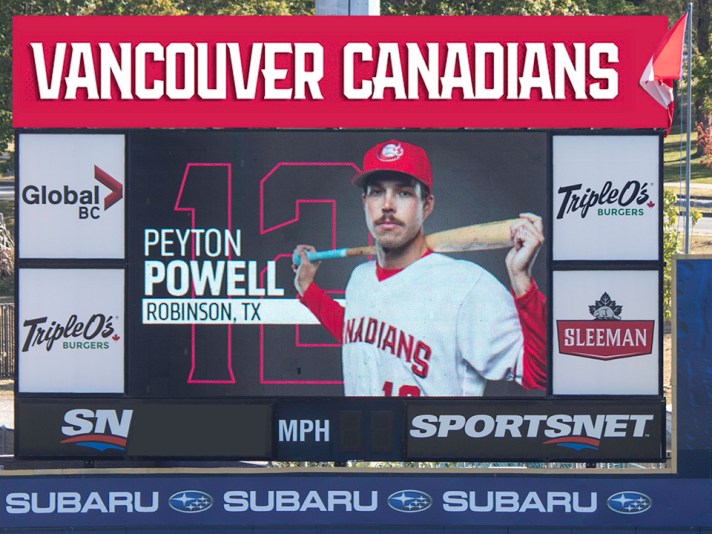
Peyton Powell File
- Born – September 2, 2000, in Waco, Texas
- Height/Weight – 6-foot-1, 195 pounds
- Bats/Throws – Left/Right
- Professional Debut – April 6, 2025, for Dunedin Blue Jays versus Clearwater Threshers. Drew a walk against Erik Ritchie.
- First Professional Hit – April 10, 2025, for Dunedin at Jupiter Hammerheads. Singled against Luke Lashutka.
- First Professional Home Run – June 19, 2025, for Dunedin at Clearwater. Homered against Adilson Peralta.
- C’s Debut – July 20, 2025, versus Spokane.
- First C’s Hit – July 20, 2025, versus Spokane against Cade Denton.
- First Professional Win – July 24, 2025, for Vancouver versus Spokane.
- Uniform Numbers – Wore number 15 with the University of Texas from 2020-2024. Wore number 12 for the Duluth Huskies in 2021 and 2022. Wore number 15 with the Dunedin Blue Jays in 2025.
- Walkup Song – “Dopamine and Jesus” by Luke Bower.
- Instagram – @peytonleepowell
- Twitter – @peytonpowell01
- Now You Know – Powell is the first Texas Longhorn to play for the Canadians since 2018 pitcher Andy McGuire.
Thanks a million again to Peyton Powell and C’s play-by-play announcer Chris Georges for putting this C’s Chat into play.
Discover more from C's Plus Baseball | A Vancouver Canadians Blog
Subscribe to get the latest posts sent to your email.


 C's Plus Baseball | A Vancouver Canadians Blog