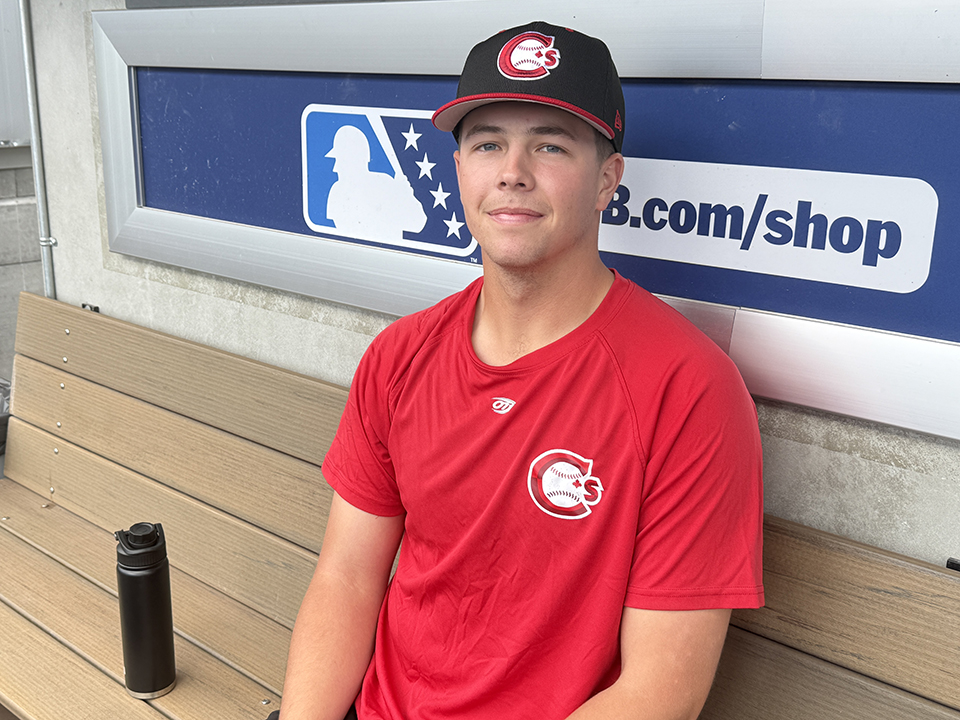
C’s Chat heads to the mound again with 2026 Vancouver Canadians pitcher Holden Wilkerson.

The Roanoke, Virginia native lettered in baseball for three years at Cave Spring High School, finishing his senior season as a Second-Team All-District selection in 2021. Wilkerson struck out nearly two batters an inning with 22 punchouts in 40 frames and posted a 1.59 earned run average. He also showed well on the summer circuit by earning five Perfect Game All-Tournament Team selections.
Wilkerson enrolled at Virginia Military Institute and went 1-0 with a 4.58 ERA in his 2022 freshman season while fanning 23 batters in 17⅔ innings. Unfortunately, the year ended due to injury. In 2023, he won three of four decisions and struck out 35 batters in 28 innings as a starter but struggled with his control with 33 walks. The 2024 season saw Wilkerson strike out 29 batters in 18⅓ innings but a blood clot in his right shoulder ended his season. The Toronto Blue Jays still selected the 2024 Southern Conference Academic Honor Roll member in the 18th round of that year’s draft after being scouted by Coulson Barbiche Jr. With a signing bonus of $150,000, Wilkerson would get back on the mound in 2025.
A strained oblique delayed Wilkerson’s debut with the Dunedin Blue Jays so he had to start out in the Florida Complex League. He won three games and struck out 23 batters in 21⅔ innings with the F-Jays. In early July, Wilkerson was assigned to the D-Jays and his most memorable outing was 7⅔ innings of relief in which he allowed three runs and struck out eight in Tampa on July 23.
Wilkerson made it north of the border in time for the C’s home opener to make his Nat Bailey Stadium debut against the Eugene Emeralds on April 7. He has been pitching out of the bullpen on days that lefthander Johnny King starts and the lefty-righty pairing has been working out well so far. After earning his first Northwest League win against the Emeralds on April 12, Wilkerson’s first road appearance resulted in four shutout innings of one-hit ball and six strikeouts to get the victory at Spokane on April 18. He ended April with just two unearned runs allowed over four-inning appearances against Tri-City on April 24 and against Hillsboro on April 30.
Against the first place Eugene Emeralds on May 7, Wilkerson enjoyed his best outing of the season with five shutout innings of one-hit ball and eight strikeouts to get the win at PK Park. His first professional save also came against the Em’s at The Nat on May 30 to preserve King’s first win in a C’s uniform.
Baseball America updated its ranking of the Top 30 prospects in the Toronto Blue Jays system and rated Wilkerson 17th.
“Wilkerson saw a large stuff jump heading into 2026, as he added 2 mph in velocity. Wilkerson now has some of the best stuff of any starter in the system, mixing a mid-90s fastball with ride and cut, a mid-to-high-80s slider, a low-80s sweeper and a firm upper-80s changeup. Wilkerson shows above-average strike-throwing ability with plus fastball control and the ability to land all of his pitches for strikes. Wilkerson is breaking out and showing back-end starter upside with good enough stuff for one-inning relief work.”
C’s Plus Baseball caught up with the 22-year-old Wilkerson during the club’s mid-May homestand against Everett. This interview has been edited for clarity.
C’s Plus Baseball – Let’s take it back to your high school career at Cave Spring and then you wound up at Virginia Military Institute. What were those experiences like?
Holden Wilkerson – High school was a lot of fun. When I was a freshman, I was on JV (junior varsity) because we had a lot of really good older guys. And then in sophomore year, I ended up making varsity as a lot of those seniors graduated. And we had a good group of guys that we basically grew up playing with our entire lives, so good team chemistry. And then I started really taking baseball seriously, getting into the showcase side of things, and talking to a couple small schools and ended up getting an offer from VMI. I accepted the offer, and then luckily for me, I accepted it just in time because the pandemic happened two days after I committed to VMI. So it was a fortunate sequence of events, I guess you would say. I ended up keeping my commitment to VMI through the pandemic. I enjoyed my time at VMI. It was definitely a big adjustment getting on campus as it’s a military academy and a lot of rules you got to learn. You got to wear the uniform, be at this place at a certain time, wearing this, that kind of thing. But no, it was a really good experience. I think VMI benefited me both as a baseball player and as a human being. I saw myself change in ways I couldn’t have imagined, and I’m thankful for the experience.
CPB – I’m sure it’s got to have changed your outlook on life and being disciplined. What was that like, as you mentioned, having to wear a military garb, so to speak?
HW – Yeah, I mean, you kind of just get to know yourself better and how your brain works. What you need to do to be successful and how to manage your time wisely to set yourself up in a position to succeed, both academically and on the baseball diamond. It was definitely a huge adjustment from high school. In high school, you got a lot of free time, get to hang out with your buddies and all that. But at VMI, I mean, our closest friends were the baseball team. We did everything together, went to class together pretty much if you had the same major. We were roommates most of the time. And then you spent at least four hours, five hours at the field every day.
CPB – You had a bit of adversity to go through, a blood clot in your shoulder. I’m sure that must have been a pretty scary time. What was that like going through that and then to be able to recover from it?
HW – Yeah, definitely a really scary situation. I think the biggest thing was putting my health first over my baseball career, which was kind of challenging to accept mentally because I was set up for a pretty big junior year going into the draft. And then a big scare, obviously, with the blood clot. We went to a couple of different clinics and never really got a clear answer. But I ended up at a specialty clinic at UNC-Chapel Hill with a great team there. And we got it all sorted out. But, yeah, it was definitely challenging trying to figure out what was going on and also communicate that to the scouts and the organizations that had interest in me and kind of see where they were at.
CPB – When did you start to feel like you were back to 100%?
HW – So the blood clot happened in March. And I started playing catch maybe early June. I was trying to prove to the organizations that had interest in me that I could still throw. My body was in a good enough spot to still play baseball. So I think I got around feeling 100% probably around the time of the draft.
CPB – Speaking of the draft, what was that experience like for you?
HW – It was a very unique experience given the blood clot. I did it all myself. I didn’t have an advisor or an agent going into the draft. So on top of the rigorous activities at VMI and the academics and all the activities going on with my blood clot, it was my responsibility to communicate my injury updates to organizations and see where teams saw me at and that kind of thing. But, no, it was a good experience. I had a really good connection with the Blue Jays. We talked a little bit in high school, but it was really late in my high school career. It wasn’t, I guess, that serious but I had a really good connection with the Blue Jays and I couldn’t be in a better spot, I don’t think.
CPB – Who did you get to celebrate the moment with?
HW – Well, I got the call that I was probably going to be selected between rounds 13 and 20. And I was at my local facility training (LAB Sports Performance) when I got that call. A longtime friend and the owner of the facility, Robbie Hebert, was with me when I got the call. So we were jumping around and he was helping me out, trying to figure out what to say back to the scouts and sort it all out before I headed home to celebrate with my parents. I got to celebrate with Robbie and then went home before the pick was put in and celebrated with my parents.
CPB – Next thing you know, you’re on your way to Dunedin. What was that like, your introduction to the organization?
HW – I didn’t really know what to expect, honestly. I’d heard the complex (Player Development Complex) was state-of-the-art and that couldn’t be more true. So that was really exciting to see all of the investments they’ve made in their player development. Everyone, all the staff, was extremely welcoming to all the new draft picks and signees. Clicked with some new players that also got signed. And, yeah, just get to know everybody really quick before I headed back to school after draft camp to finish my degree.
CPB – And what was that degree in?
HW – Economics and Business.
CPB – Very nice. Well, congratulations.
HW – Thank you.
CPB – What was that like trying to keep all your priorities together? I guess this is where the discipline comes into play again.
HW – Yeah. I had to overload on credits. I took 20½ credits that fall after draft camp. So that was really tough. I was in class pretty much from 8:00 to 3:00 every single day and then get down to the field and get my baseball work in and still manage the lifts and the homework and trying to maintain my body weight and get bigger and stronger. It was challenging for sure, but I’m happy I did it.
CPB – You were talking about some of your new teammates, who did you really hit it off with right away?
HW – My roommate in draft camp was Troy Guthrie. And I’d say that’s probably the guy I hit it off with the most. And then Jonathan Todd. We were in the same conference in college, so I knew of him. So getting to know him was sort of fun. And then Johnny King as well.
CPB – I want to ask you now about your pitch mix. What is it that you are throwing right now?
HW – I’m throwing a four-seam fastball, a slider, a sweeper, and we’re working on the fourth pitch. It’s going to be some sort of two-seam sinker variant.
CPB – The slider, did you figure that out yourself or did somebody teach you?
HW – I learned the grip from Aaron Lesiak. He was my pitching coach sophomore year at VMI. He was only there for a year but I was struggling with command at the time. I was fastball, curveball only. So we thought a shorter breaking ball would be a good option. He taught me the grip and at first, it was more of a cutter shape. But as the pitch sort of developed, it became a true slider and that’s been my bread and butter.
CPB – The sweeper, I don’t know how you characterize it but how did you develop that?
HW – Oh, yeah. So that was this offseason when we had our exit meetings last year. The player development staff thought that would be a good direction for me to trend towards, a bigger, slower slider. So just kind of playing catch with that in the offseason. There’s a major leaguer with the Red Sox who’s from my hometown who I get to train with. So I’m in the offseason, and he throws a really good sweeper. So kind of picking his brain during catch-play in the offseason and just working on the feel of things was really the main goal for the offseason.
CPB – And who is this former major leaguer?
HW – Zack Kelly. He’s with the Red Sox.
CPB – Okay. You said you’re working on a fourth pitch. Can you talk about how that’s coming along?
HW – Yeah. It’s been up and down at the beginning of the season. I had a decent feel for it. I’m not throwing it a lot, maybe 5% of the time. But it’s a two-seam fastball. And right now the velo is a little bit lower than what we would like it to be. It’s in the 89 to maybe 92 (miles per hour) range. And we want to see that tick up a little bit, probably closer to my four-seam. So, yeah, just trying to figure out how to get the same movement with the increased velocity.
CPB – How do you feel your pitch mix works against the opposing batters?
HW – I think it’s good. I have a really good feel for the fastball. I can throw a first strike any time I want, and I’m just as confident. And my slider, I can throw that in any count as well and then kind of expand the strike zone with the sweeper, try to get chase, or maybe just make the strike zone look a little bit bigger to the hitter. So, I think it plays really well.
CPB – Since you’ve been here in Vancouver. You’ve been a tandem starter with Johnny King, who throws heat for the left side. You do the same for the right side. How’s that partnership been working out for you?
HW – It’s a lot of fun. I mean, since we’re on the same schedule, we do everything together. We have the same light, medium, high-intent throwing days all the time. So, we play catch together, we lift together, condition together, and then hang out off the field as well. So, it’s been a lot of fun. I like coming in after Johnny because I think it’s a different look. Obviously, he’s a left-handed pitcher. I’m a righty. So, I think it’s maybe to my advantage a little bit more if they’re game planning for Johnny. And then here I come rolling out of the pen in the fifth, maybe the fourth, depending on what Johnny did.
CPB – How does that affect your preparation when you don’t exactly know when you’re coming in?
HW – Yeah, I mean, pregame it’s really just getting my body loose. And then when I’m in the pen waiting, I might get up and do a small stretch or maybe some armbands between innings. And kind of just listening, keeping track of where his pitch count’s at and when I think I might go into the game and just mentally get in that headspace to go compete.
CPB – What’s it been like pitching here at Nat Bailey Stadium?
HW – It’s an awesome experience, and that’s great. The fans are always into the game. It’s always packed out. It’s definitely a significantly different environment than TD Ballpark in Dunedin. It’s great. The weather’s great. I mean, it’s a 10 out of 10 experience for me. I love it.
CPB – Just to start to wrap things up here, who would you say is your funniest teammate?
HW – Funniest teammate? Probably Daniel Guerra.
CPB – Favourite Major League team or player growing up?
HW – I didn’t have one growing up, honestly.
CPB – Okay. Fair enough. The final question. The Canadians have lots of different uniforms. The Nat, the white one, red, black, blue, gray. Do you have a favourite?
HW – I like The Nat uniforms. I also really like the blues. I think it’s a classic look, and we just got those new matching hats, which is awesome. So, I’d say it’s probably between those two.
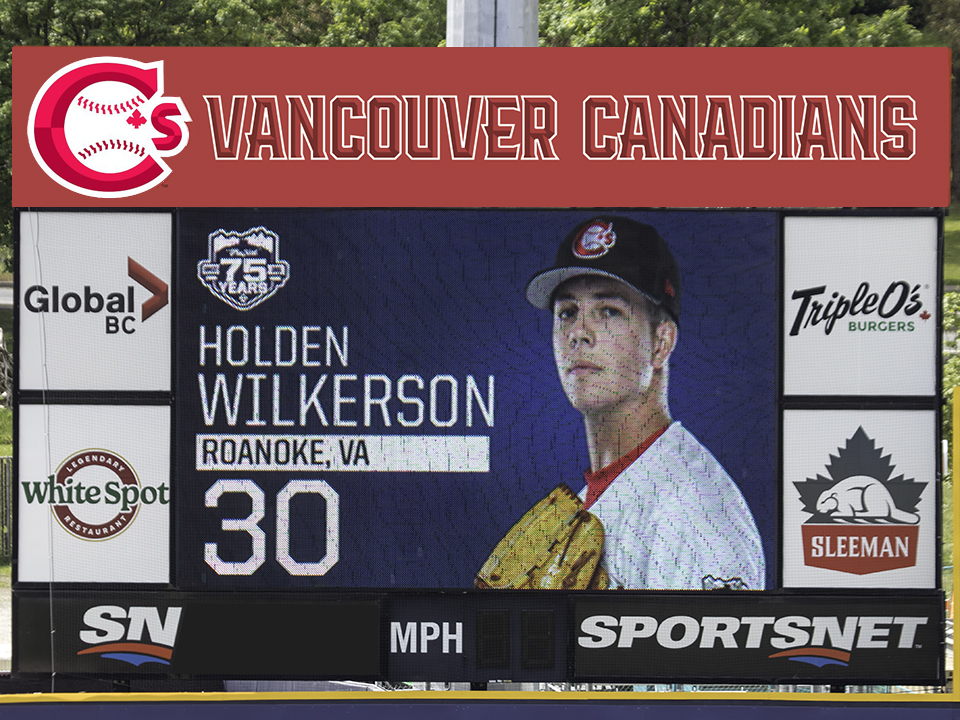
Holden Wilkerson File
- Born – June 7, 2023 in Roanoke, Virginia.
- Height/Weight – 6’4”, 205 lbs.
- Bats/Throws – Right/Right
- Uniform Numbers – Wore number 23 for the Virginia Military Institute Keydets from 2022-2024. Wore number 20 for the Florida Complex League Blue Jays and number 36 for the Dunedin Blue Jays in 2025.
- Instagram – @13holden03
- Mound Music – “Too Late for Love” by Def Leppard.
- Professional Debut/First Professional Win – May 23, 2025, for the Florida Complex League Blue Jays versus the FCL Tigers. Pitched three shutout innings with three strikeouts.
- First Professional Strikeout – May 23, 2025, for the FCL Blue Jays versus the FCL Tigers. Struck out José Dickson looking.
- C’s Debut – April 7, 2026, versus the Eugene Emeralds. Pitched 3⅔ innings of two-run ball and struck out seven.
- First C’s Win – April 12, 2026, versus the Eugene Emeralds. Pitched 3⅓ innings of two-run ball and struck out two.
- First Professional Save/C’s Save – May 30, 2026, versus the Eugene Emeralds
- Fun Fact – Wilkerson is the first VMI Keydet to be drafted by the Toronto Blue Jays since third baseman Kelly Sweppenhiser was taken in the 44th round in 2003. The first Keydet hurler who was selected by the Jays was righthander Jeremy Harper in the 14th round in 2006.
Thanks a million to Holden Wilkerson and C’s Media Relations Assistant Alexa Liptak for closing out this episode of C’s Chat.
Discover more from C's Plus Baseball | A Vancouver Canadians Blog
Subscribe to get the latest posts sent to your email.


