
The latest C’s Chat is with 2024 Vancouver Canadians pitcher Chris McElvain.

The Columbia, Tennessee native was introduced to one of the harsh realities of baseball, being traded. After spending the majority of spring training working out in Arizona, McElvain was dealt by the Cincinnati Reds to the Toronto Blue Jays in exchange for infielder Santiago Espinal on March 20. The righthander was taken by the Reds in the eighth round of the 2022 MLB Draft out of Vanderbilt.
Heading into the 2022 MLB Draft, Baseball America rated McElvain as the 169th-best prospect.
“McElvain committed to Vanderbilt before he threw a pitch in high school and in 2022…A 6-foot, 205-pound righthander, McElvain is a strike thrower with average stuff across the board, headlined by a fastball that sits around 92 mph and gets up to 95 with good carry and the induced vertical break numbers to back it up. McElvain throws a slider in the low 80s and has also added an upper-80s cutter this spring, with a fringe-average changeup in the mid 80s as well. Analytically-inclined teams will like the characteristics of McElvain’s fastball and a strong track record of control dating back to his high school days—though his walk rates are a bit higher than his reputation as a control artist—while more traditional scouting teams could be more skeptical about the impact of his stuff and his overall upside potential.”
Prepping at Summit High School in Spring Hill, Tennessee, McElvain impressed USA Baseball officials enough that they selected him to pitch for the 15-and-under USA Baseball squad at the Pan American Games in Mexico in 2015. He was 1-0 with a 3.38 earned run average in eight innings to help USA win gold after downing Columbia in the final.
As a two-way player at Summit, McElvain hit .422 and posted a 0.73 ERA in his four-year career. In his 2019 senior campaign, he struck out 103 batters and only walked 11. McElvain dabbled as a shortstop and catcher in high school and with his travel team but it was decided that his strong arm would go to better use on the mound. He wowed scouts and college recruits as a freshman during a senior high school showcase event.
McElvain would head to Nashville to join the Vanderbilt Commodores. His 2020 freshman season consisted of just six relief appearances (four of them scoreless) and 9-1/3 innings before it was cut short due to the pandemic. On the 2020 Vanderbilt roster was 2022 Vancouver Canadians utility man Harry Ray.
Baseball did resume for McElvain later that summer as he headed to the summer collegiate Northwoods League to join the Wisconsin Rapid Rafters. He helped them reach the playoffs as he struck out 11 batters over six shutout innings but Wisconsin was blanked by La Crosse 1-0 on August 21. He was 3-0 with a 0.89 ERA, a 41-10 strikeout/walk total over 33-1/3 innings with the Rafters.
The 2021 season saw McElvain assert himself of a key member of the Commodres bullpen. He compiled a 5-1 record with two saves, a 4.34 ERA and 58 strikeouts over 45-1/3 innings. The season highlight was contributing six strikeouts over 2-1/3 innings of one-run relief to help Vandy knock off Georgia Tech to win the Nashville Regional on June 6. That helped the Commodores eventually reach the College World Series. McElvain then got in another round of summer college ball by joining the Brewster Whitecaps of the Cape Cod League. Though he pitched just 13 innings, he went 2-0 and struck out 13 batters.
Vanderbilt head coach Tim Corbin had this to say about the eldest McElvain on the Commodores official website prior to his 2022 campaign.
“Mac is a team guy through and through. He came to us as a kid who could catch, play any infield position and pitch. He has been a very dependable pitcher for us and served every role as a pitcher. I love the fibers of the kid … you are always going to get his best. He has really transformed his body in the weight room and improved his fitness levels a great deal. We will give him the ball a lot this year.”
With first-round picks Kumar Rocker and Jack Leiter moving on from Vanderbilt, McElvain became the Friday starter for the Commodores in 2022. He showed the qualities of an ace early on by racking up 13 strikeouts over seven innings of two-run ball against Hawaii on March 4. McElvain was named the Southeastern Conference (SEC) Pitcher of the Week for tossing seven innings of a combined no-hitter that included nine strikeouts against Kentucky on April 22. Another strong outing came in the Corvallis Regional when McElvain yielded just one run over seven innings and struck out 11 against New Mexico on June 4. In total, he won six of 11 decisions with a 4.27 ERA and struck out 100 batters over 86-1/3 innings.
Though Chris McElvain has moved on from Vanderbilt, his brother Evan McElvain has joined the Commodores as a freshman lefty this season and brother Ethan McElvain is currently a catcher at Nolensville High School in Tennessee.
After receiving a signing bonus of $175,700, the Reds assigned McElvain to the Daytona Tortugas of the Florida State League in 2023 and pitched four shutout innings in his pro debut at St. Lucie on April 8. He posted nine strikeouts over five shutout frames at Bradenton on April 20 and got his first professional win on May 9 against St. Lucie with three earned runs allowed over five innings while striking out four. He tossed 50-1/3 innings for the Tortugas, splitting six decisions while striking out 53 batters against 19 walks.
That resulted in a promotion to Dayton on June 20. His first High-A victory came versus Beloit with five innings of one-run ball and four strikeouts on August 2. A career-high six innings of one-run ball and six strikeouts led to another win against Fort Wayne on September 5. McElvain spilt four decisions and logged a 4.53 ERA while ringing up 34 batters over 45-/23 innings with Dayton.
Assigned to Vancouver after being traded to the Blue Jays organization, McElvain’s debut came in preseason action with three shutout innings against UBC on April 3. He had the honour of starting the home opener and put together four scoreless stanzas against Hillsboro on April 9. McElvain limited host Tri-City to one run over six innings while fanning five on May 2. His first win with the C’s was on May 17 when he blanked Spokane with five scoreless frames and five Ks on the road. He wound up in the winner’s circle again with another road victory with five innings of two-run ball and seven strikeouts at Hillsboro on May 24.
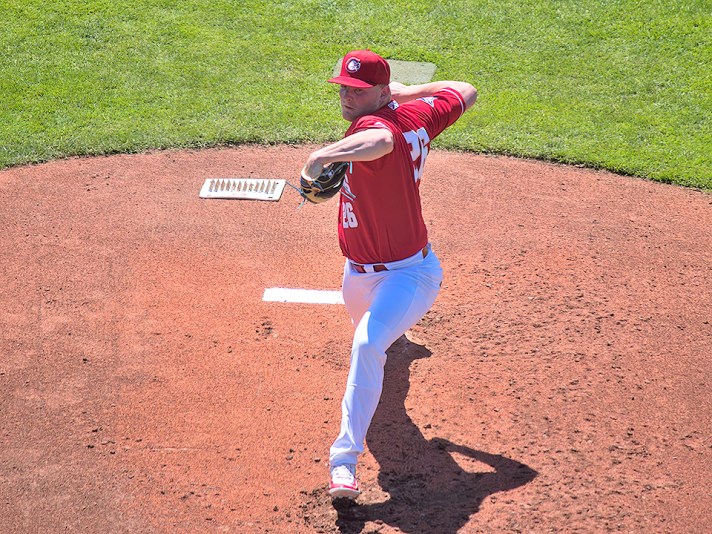
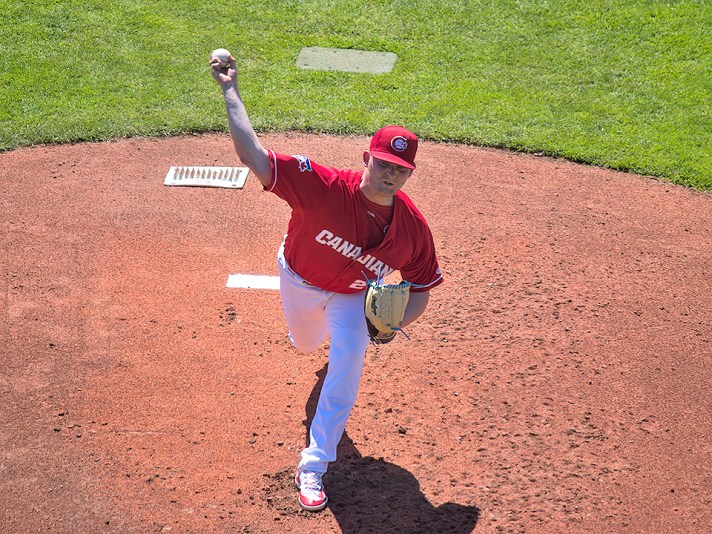
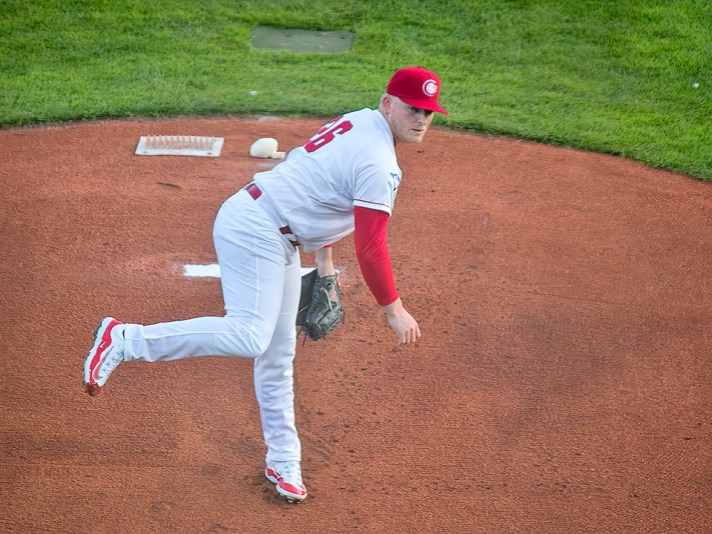
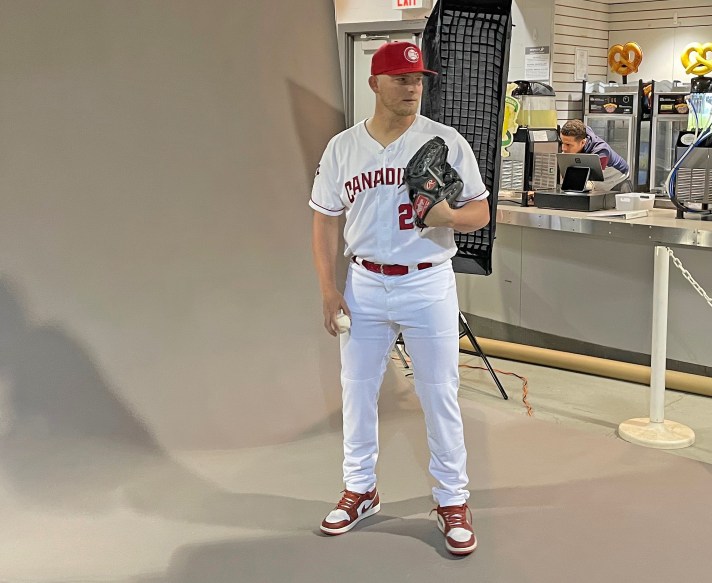
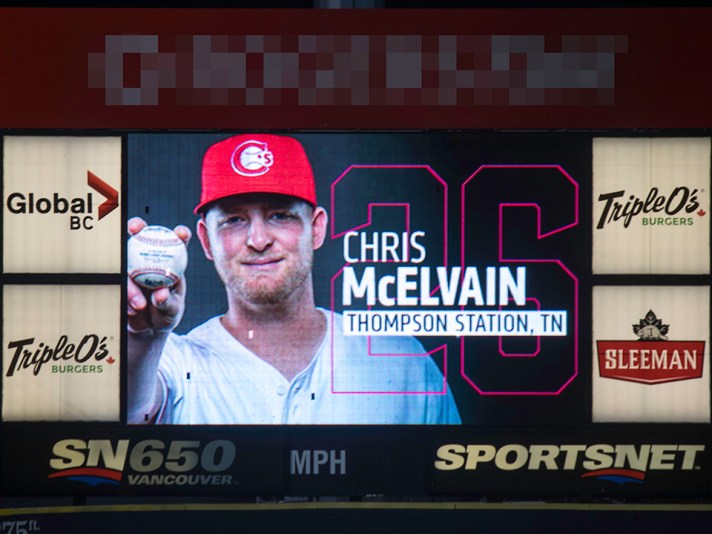
C’s Plus Baseball had a conversation with the 23-year-old McElvain during the team’s May homestand against Everett. This interview has been edited for clarity.
C’s Plus Baseball – You get traded by the Cincinnati Reds to the Toronto Blue Jays. How did you find out about it? Who told you first?
Chris McElvain – Actually, it was the minor league GM who told me. He pulled me aside. I just got done throwing earlier that day. I threw three innings in one of the spring training games and when I was done, I went and did all of my recovery stuff. He texted me and asked me if I was still there. I answered him back. He asked to meet and then I found out they had traded me to the Toronto Blue Jays.
CPB – How did you react when you found out?
CM – I was kind of speechless in the moment. I had a lot of emotions. That was the team that drafted me. That was kind of where I started. My time there was a little bit short, and that’s not technically what I expected. I had seen some guys get traded but they were typically guys that had been in the organization for a while. I wasn’t sure what to think at first but I was excited. There’s always a new adventure you’re going on so I was excited about it and it’s been great.
CPB – You get traded for a major leaguer, someone who was at the All-Star game in 2022, the year you were drafted. I’m sure that had to make you feel good that the Blue Jays obviously saw something in you.
CM – Absolutely. That’s never a bad thing and it’s definitely not going to make you feel like you’re not wanted. It wasn’t the fact that the Reds didn’t want me and that’s not how I felt. I felt like I was moved on to a new opportunity where there was a team that wanted to take a chance on me.
CPB – Who got a hold of you from the Blue Jays when you finally got in touch with them? How did that conversation go?
CM = The first person that called me was (director of minor league operations) Charlie Wilson. It was kind of short and sweet, like, ‘When can you be out here?’ Because I was in Arizona and I had to make that commute to Florida for the last week of spring training. He was just making sure that I knew that they were excited to have me and that they wanted to figure out how they could get me down there the fastest. He kept it short because he respected the fact that I had to call my family and call my extended family, and I hadn’t gotten to talk to anybody about it because it had just happened.
CPB – What was that whole process like? You had to move, as you said, basically cross-country from Arizona to Florida. How long did that process take for you to finally get settled in at Dunedin?
CM – I don’t know that I would really say that I got settled in. I was only there for a week. So I got the call, I got traded, packed my stuff up and I was out the next day. Then I got down there, I went through the physical stuff and then I kind of got into a little bit of a routine, trying to get ready for an outing. I had one outing and got shipped out so there wasn’t very much time spent down there. Most of the time that I did have down there, I was getting to know the pitching coordinators and all of the coordinators, the strength staff, the athletic trainers and whatnot. But I wouldn’t say that I really got enough time to sit around and really get comfortable there.
CPB – I’m sure you had a chance to at least see the Player Development Complex. What did you think of it? What were your first impressions?
CM – I was very impressed. It was very nice and they keep it clean and they keep it put together. It was a really cool experience seeing that, for sure, especially since it’s new.
CPB – Was there any piece of technology that really impressed you that maybe you hadn’t seen before, or anything you think that’s really going to help you down the line?
CM – I don’t know if there was one piece specifically but I know that the pitching lab was pretty cool. They’ve got different machines and stuff in the pitching lab that they can read, like body movements and stuff like that, that I think could help. Down the road with the way I’m moving on the mound and help with consistency and things like that.
CPB – You got to see one familiar person in the Blue Jays system, your former teammate with Vanderbilt, Harry Ray. What was that like getting back together with him?
CM – That was cool. I got to talk to him and he’s now moved on to a different role. It was nice to be able to catch up and see somebody that I haven’t seen since 2020 so that was cool.
CPB – The 2020 season. The pandemic affected everybody and cut your season short. That was your only season with Harry as it turned out. What was that like just trying to get your feet wet at the college level?
CM – It was different, that’s for sure. It was an experience that you can’t prepare yourself for. Going into your freshman season of college, you’re getting ready to open up with Kentucky that weekend. That’s your first SEC series of the year, and all of a sudden the coach calls you and they tell you to come to the facility. The next thing you know, coach is telling you that your season’s over and we’re all getting sent home. They’re canceling school for two weeks and we’re going to pick up school online. It was crazy and it was nothing that you can prepare yourself for but I would say the silver lining in that whole time was the amount of time I got to spend with my brothers and my family and that was really cool because all three of us play baseball. We haven’t gotten a lot of time to just kind of hang out and spend time together and do different things that we don’t usually get to do during the spring. That was the silver lining but there was absolutely no baseball until later that summer. Obviously workouts were a challenge.
CPB – Did you get together with some of your college teammates or maybe high school or anything like that?
CM – No, I mostly just stuck it out with my brothers. I’ve got a brother playing at Vanderbilt right now, and then I’ve got a brother that is in high school at one of the schools in Tennessee. And at the time, my brother (Evan) was in high school, my middle brother that’s at Vanderbilt. We just kept throwing once we went home, kept working out and just made the best of what we had.
CPB – Your time with the Commodores under Tim Corbin, he’s certainly one of the best college coaches around. What was that like being a Commodore for three seasons?
CM – It was really cool and it was a big learning experience. I learned a lot there and I think that’s made me into the player that I am today, for sure.
CPB – The 2021 season, you get to the College World Series. What was that like being in Omaha?
CM – That was really cool. It was still under some challenging circumstances. COVID was still kind of floating around and they were still testing us and all of that. But for the most part, you know, playing in front of those fans, that definitely didn’t disappoint. We had a packed stadium towards the end and that place is rocking when you have a full stadium. That was a really cool experience and just being on the highest level of college baseball right there was also super cool.
CPB – Another great moment for you was in 2022. You’re moving into the rotation full time and were part of a no-hitter against Kentucky. Did you have any idea what was going on at the time when it was happening?
CM – I didn’t really know but I knew that I was pitching well. I didn’t know that I hadn’t given up any hits. I knew that I was pitching well and I was really hoping that I was going to finish the game. But I didn’t have any idea until they took me out and I looked up at the scoreboard that there was no hits on the board. So that was definitely an experience that I haven’t been in very many times.
CPB – What was working for you that day?
CM -Everything. That was just a day where I was throwing everything up to the plate and I was getting a whole lot of swing and misses. My defense helped me out a few times behind me and it was all falling (into place) for me that day.
CPB – You’ve certainly had a number of high-profile teammates (in Vanderbilt), Kumar Rocker and Jack Leiter among them. Did that help you to raise the bar and meet their standard?
CM – I don’t know if it was really about meeting standards as much as it was just trying to pitch to the best of your ability and we’re all out there trying to do the same thing. I think that you have those guys that pitched well while they were there, and we’re all trying to go out there and pitch well. I think it just made all of us work just that much harder, you know, because we all wanted to go out there and perform. We all wanted to go out there and keep as many runs off the board as possible. It was a collective agreement that we wanted to all go out there and set that standard.
CPB – When did you first start pitching?
CM – I started pitching in 2015. That was the year that I played for Team USA, and really I hadn’t done much pitching. I had kind of been on the mound a few times but not really considered it like I was going to be a pitcher. But then when I made Team USA and I ended up starting Game 1 of the tournament that we were playing in in Mexico and I think from there, that’s kind of where I saw the idea of being a pitcher start to come alive. I never really had plans of just pitching. That was just what I enjoyed doing for Team USA, and I was on the roster as a catcher as well. I caught in high school but my plan was to never just become a pitcher.
CPB – How did being a catcher help you out as a pitcher?
CM – Oh, it’s definitely helped me. One of the biggest pieces that’s helped me is being able to read swings, and when you throw one certain pitch and you see how the batter reacts to that or how he swings at that. I think it’s helped me have a plan to set up for the next pitch.
CPB – I want to ask you what pitches you’re throwing right now. What is it that you do throw?
CM – I’m throwing a four-seam, a two-seam, a change-up, a cutter and a slider.
CPB – What would you say is maybe your favorite or your second best pitch?
CM – I’d say one of my better pitches is probably the cutter.
CPB -Was there anyone who taught you that?
CM – I kind of learned it on my own while I was in college.
CPB – The changeup, is it a split changeup or a circle?
CM – It’s kind of an in-between. It’s not a true circle and it’s not a true split. It’s something that I’ve been playing around with and trying to figure out what’s going to help me knock down some of that velocity so that there’s a bigger speed change there.
CPB – Is it a big challenge to work with a vast repertoire? I know some guys usually have just two or three pitches but how big a challenge is that for you to try to maintain your level of all those pitches you have?
CM – I think it’s just understanding what worked good in the game and what didn’t work so good. Then you have a plan going forward in the bullpen for the next week to set you up for that next outing. It’s not something that you just hammer on all the time where you’re throwing every single pitch for 50 pitches in the bullpen but I think it’s a challenge. I think it’s something where you touch on it in your bullpen before the next outing and you make corrections from there and then going forward you have a better plan of how to use that pitch.
CPB – Who would you say has helped you develop your pitching style? Are there any coaches that stand out?
CM – I would say no one in specific that’s helped me form my pitching style just because I wasn’t necessarily the guy that was going to go out there and just blow it by everybody. But when I got on the mound, even in high school, I just had this mentality that I was going to go right at you and I was going to throw as many strikes as possible. I was going to make a plan accordingly after strike one or after strike two. I definitely had some help from Scott Brown at Vanderbilt with pitch shapes and things like that. I haven’t changed the way I pitched since I was in high school as far as my mentality and how I approach the game.
CPB – One thing that you brought up when I first met you on Media Day, you were in spring training in Arizona, and then you had a little bit of a taste in Florida and how different that your pitches reacted. How different was it pitching at spring training in Arizona and in Florida?
CM – Yeah, especially towards the end of spring training in Arizona when it gets hot. You’re going to notice that you’re hot but you’re not really sweating. And the air is so dry there that the sweat just pretty much evaporates off of your skin. Whereas when I went down to Florida for that one week, I had one outing and I was sweating. There was humidity and the ball felt like it was just coming out better because the baseball had something to grab onto. That humidity helps with the way that your pitches move so it was definitely a big change and it was definitely something that I hadn’t really experienced that closely together before.
CPB – What’s it been like pitching here in the Blue Jays organization? How different has it been from Cincinnati?
CM – I don’t think there’s a huge difference as far as, you know, the coaches approach. Everybody’s trying to make you better, everybody’s trying to get you to throw strikes and get you to get outs. That’s the name of pitching but I think that every organization is going to do it a little bit different. One thing that the Blue Jays do maybe a little bit different is they focus more on the way that your body is moving alongside of the ground force mound that I talked about a little bit ago. They use that information and they help you going forward into your season with how your body’s moving on the mound and things like that. Whereas when I was with the Reds, something that I focused on a lot was the shape of my pitches. I think that there’s just different focuses depending on what organization you’re in and what the coordinators really want you to focus on.
CPB – Did you have a favourite major league team or player growing up?
CM – No, I don’t really have a favourite team. I grew up a Yadier Molina fan just because I was a catcher. So I watched him as many times as I could and took away things that I saw while he was catching. But as far as a specific team goes, I just watched baseball when it was on. It didn’t matter who it was.
CPB – Final question I want to ask. The Canadians have five uniforms—red, black, blue, white and gray. Do you have a favourite of any of them?
CM – No, I don’t really have a favourite. I’ve been wearing white at home. (On May 10 versus Everett), I’m wearing red. I wore gray last week on the road (at Tri-City on May 2). I don’t really have a favorite but I like the variety that we have, for sure.
Chris McElvain File
- Born – September 15, 2000 in Columbia, Tennessee
- Height/Weight – 6-foot-0, 205 pounds
- Bats/Throws – Right/Right
- Uniform Numbers – Wore number 35 with the Vanderbilt Commdores from 2020-2022, wore number 27 with the Daytona Tortugas and 23 with Dayton Dragons in 2023.
- Mound Music – “Devil’s Dance” by Metallica & San Francisco Symphonic Orchestra.
- Instagram – @mcelvainchris
- Twitter – @McelvainChris
A million thanks to Chris McElvain and C’s broadcaster Tyler Zickel for this instalment of C’s Chat.
Discover more from C's Plus Baseball | A Vancouver Canadians Blog
Subscribe to get the latest posts sent to your email.


 C's Plus Baseball | A Vancouver Canadians Blog